“Conductive” does not describe one performance result. A printed specimen can be tested for resistance, calculated resistivity, response to strain, temperature drift, heating, or electromagnetic shielding. Each result depends on its material and test setup.
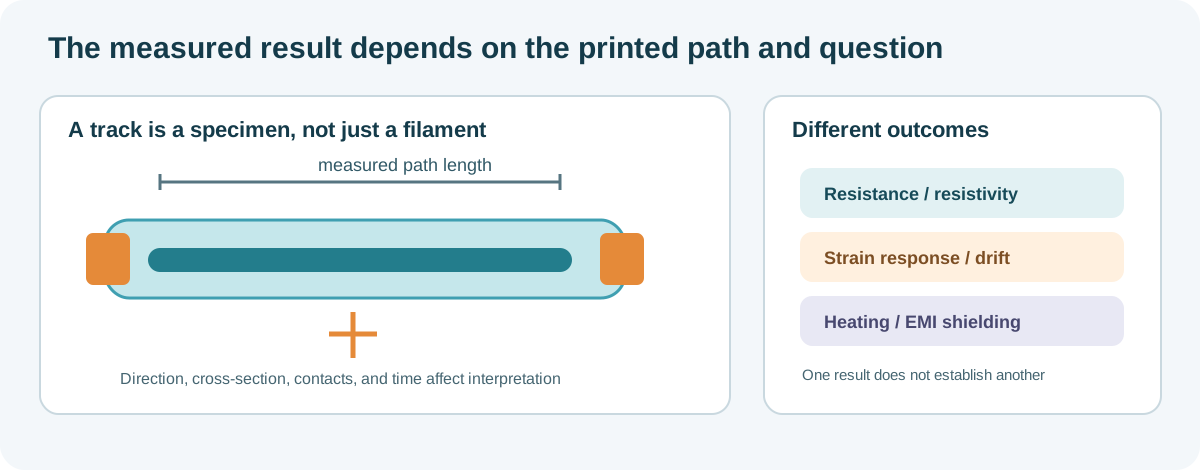
Match the measurement to the question
Resistance is measured across a particular path and contact arrangement. Resistivity or conductivity accounts for specimen dimensions in the reported method; a track, a multilayer body, and a hybrid structure can therefore produce different results even with related feedstock. One study examined conductive PLA and PVDF from individual tracks through layered structures and reported effects from geometry and arrangement. Read the study .
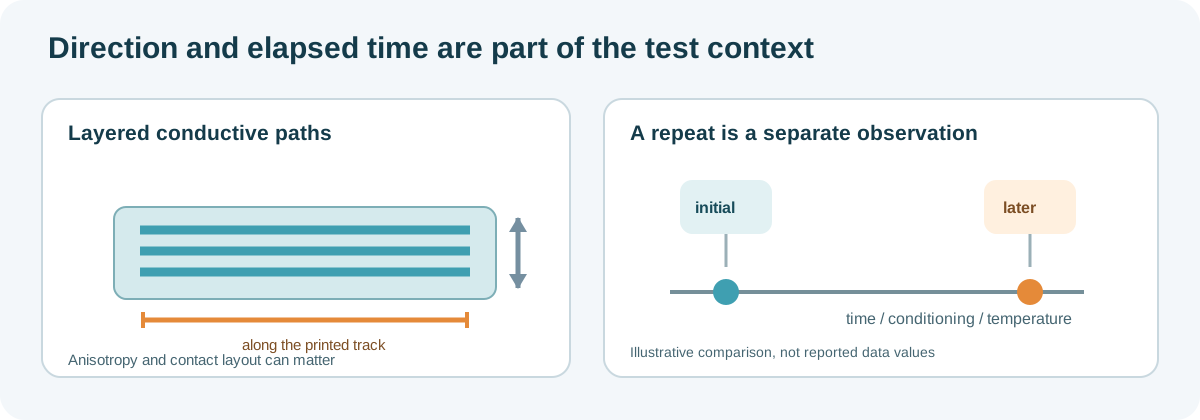
Repeatability and drift also matter. A 2026 study of one conductive PLA varied print temperature, speed, and layer height, then measured apparent resistivity initially and after 50 hours. It reported parameter-related differences and time-dependent drift; the observations do not establish a stable value for another product or a production setting. See the study .
Sensor response and shielding are separate outcomes. A CNT/PLA study measured electromagnetic-interference shielding for its selected composite and specimen conditions. Its reported shielding result is not a circuit rating, device-compatibility claim, or compliance finding. Read the study .
Before comparing results, note composition, printed geometry, direction, electrode/contact method, units, temperature, conditioning, elapsed time, and the exact outcome. No article here establishes safe voltage or current, electrical insulation, product compliance, or suitability for a safety-critical device.
Back to top ↑