A property table can be useful and still tell you very little about your particular print. Before comparing numbers, ask what object was measured, how it was made, what property the test measured, and what decision you hope to make. A result for one printed specimen is evidence about that specimen and test; it is not a rating for every part made from the same polymer family.
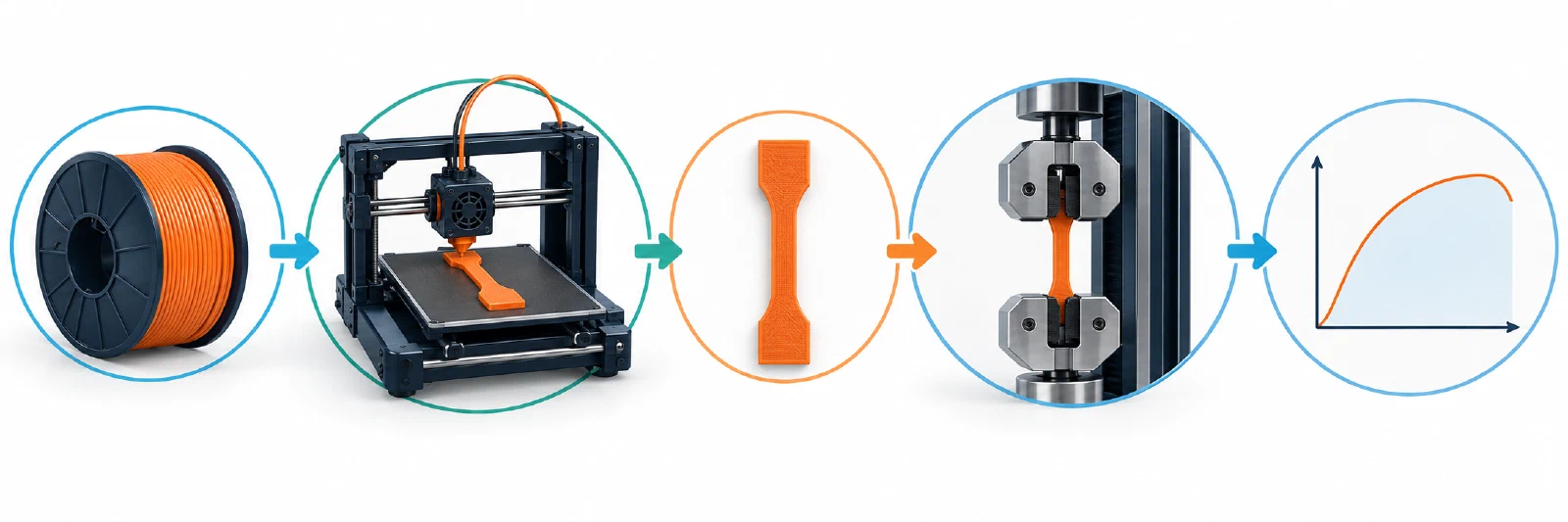
Start with the property, not the headline number
“Strength” can mean resistance to different kinds of loading. Tensile, flexural, impact, shear, and pull-off tests impose different conditions and produce different answers. Thermal measures also differ: heat-deflection temperature (HDT) and Vicat softening temperature use defined test setups. Neither is, by itself, a guaranteed continuous-use temperature for a finished part.
| Reported result | What to look for | What it does not establish by itself |
|---|---|---|
| Tensile strength | Test method, specimen, orientation, loading rate, and whether the reported value is yield or break | Strength in bending, impact, or a particular part geometry |
| Flexural result | Span, specimen dimensions, method, orientation, and the reported endpoint | A universal allowable load |
| Impact result | Notch condition, impact method, specimen orientation, and energy or normalized unit | Resistance to every drop or collision |
| HDT or Vicat | Method, applied load where applicable, specimen state, and conditioning | A safe operating temperature or time-at-temperature limit |
| Dimensional change | Which features and axes were measured, the reference state, and measurement resolution | A correction factor for another geometry or process |
| Surface or coating result | Substrate, coating, surface preparation, and failure mode | Adhesion or durability for a different material pair |
Keep unlike endpoints separate. A higher value in one test does not automatically mean a part is “better” overall.
Reconstruct the tested object
Before using a number, capture the material identity as specifically as the source gives it: polymer, blend, reinforcement, product, color or formulation if stated, and document revision. Then record the production route. A molded resin value, a printed coupon, a manufacturer’s printed-specimen table, and a maker’s measurement of a finished part are different evidence objects.
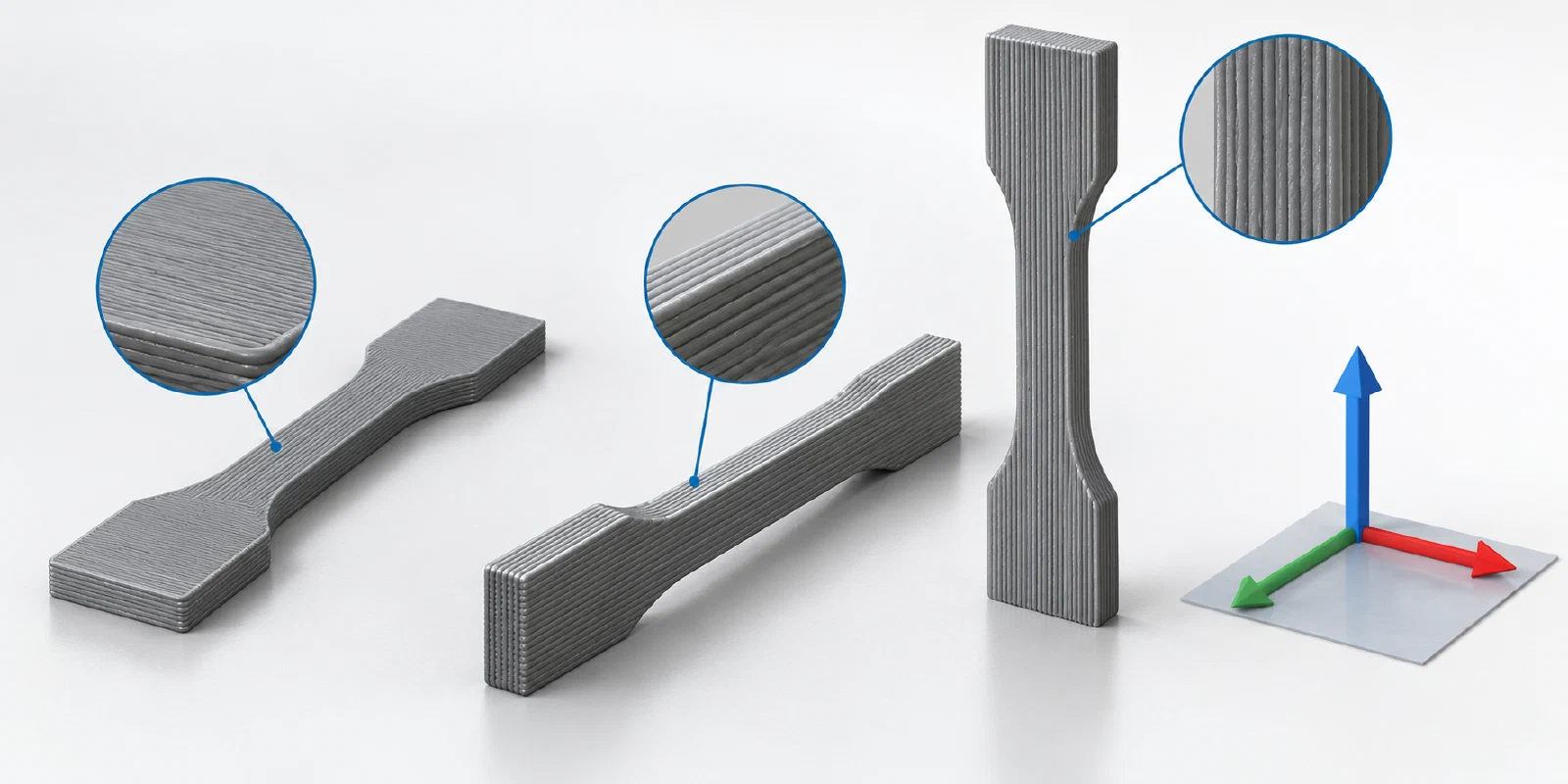
For printed results, look for printer and process, specimen geometry, infill or wall construction, layer direction, orientation, conditioning, treatment, exposure, and comparator. If any are absent, preserve that absence. It is not safe to fill it in from a typical profile.
One concrete example is the May 2022 UltiMaker Tough PLA technical data sheet . It says its mechanical specimens were 3D printed and reports flat XY, side YZ, and upright Z orientations. Its stated setup includes an UltiMaker S5 Pro Bundle, 0.15 mm layers, a 0.4 mm AA print core, 100% infill, and at least 24 hours at room temperature before measurement. Those details explain what the sheet describes; they do not prescribe a profile for another printer or part.
Read the method and result together
The same sheet reports HDT of 58.3 ± 0.7 °C under ISO 75-2/B at 0.455 MPa and Vicat of 63.7 ± 0.3 °C under ISO 306/A120. These are method-defined results on the sheet’s specimens. They should not be rewritten as “Tough PLA is safe up to 58 °C” or “the part will soften at 64 °C.” Continuous use depends on geometry, load, duration, environment, and other factors the two results do not settle.
Method names alone do not guarantee a fair comparison. NISTIR 8059 reviews limits in applying conventional polymer test standards to additive-manufactured materials, including anisotropy and specimen issues. Its examples are a technical review, not a current standard or an acceptance rule. Compare the actual specimen and method notes, not just two matching labels.
Compare like with like
NIST distinguishes repeatability—agreement when measurement conditions stay the same—from reproducibility when conditions change. A useful reproducibility statement identifies which conditions changed, such as the method, instrument, location, or time. “Accurate” or “precise” without a defined quantity is not a substitute for uncertainty or variation information. See NIST TN 1297’s terminology .
When you compare two results, write down:
- the exact material and document or study;
- the measured property, method, units, specimen, and orientation;
- the as-printed or treated state, conditioning, and exposure;
- the comparator and changed conditions;
- sample variation, uncertainty, failure mode, and missing details.
If the methods or states differ, describe the results side by side rather than ranking them. A short static test also leaves questions about repeated loading, creep over time, wear, and fatigue unanswered. One study of printed PLA reports that a specimen under 10 N was still deforming after 170 hours; that is a time-dependent observation for that test, not a load allowance for an arbitrary part. Read the study . Wear and fatigue likewise need evidence that measures those behaviors.
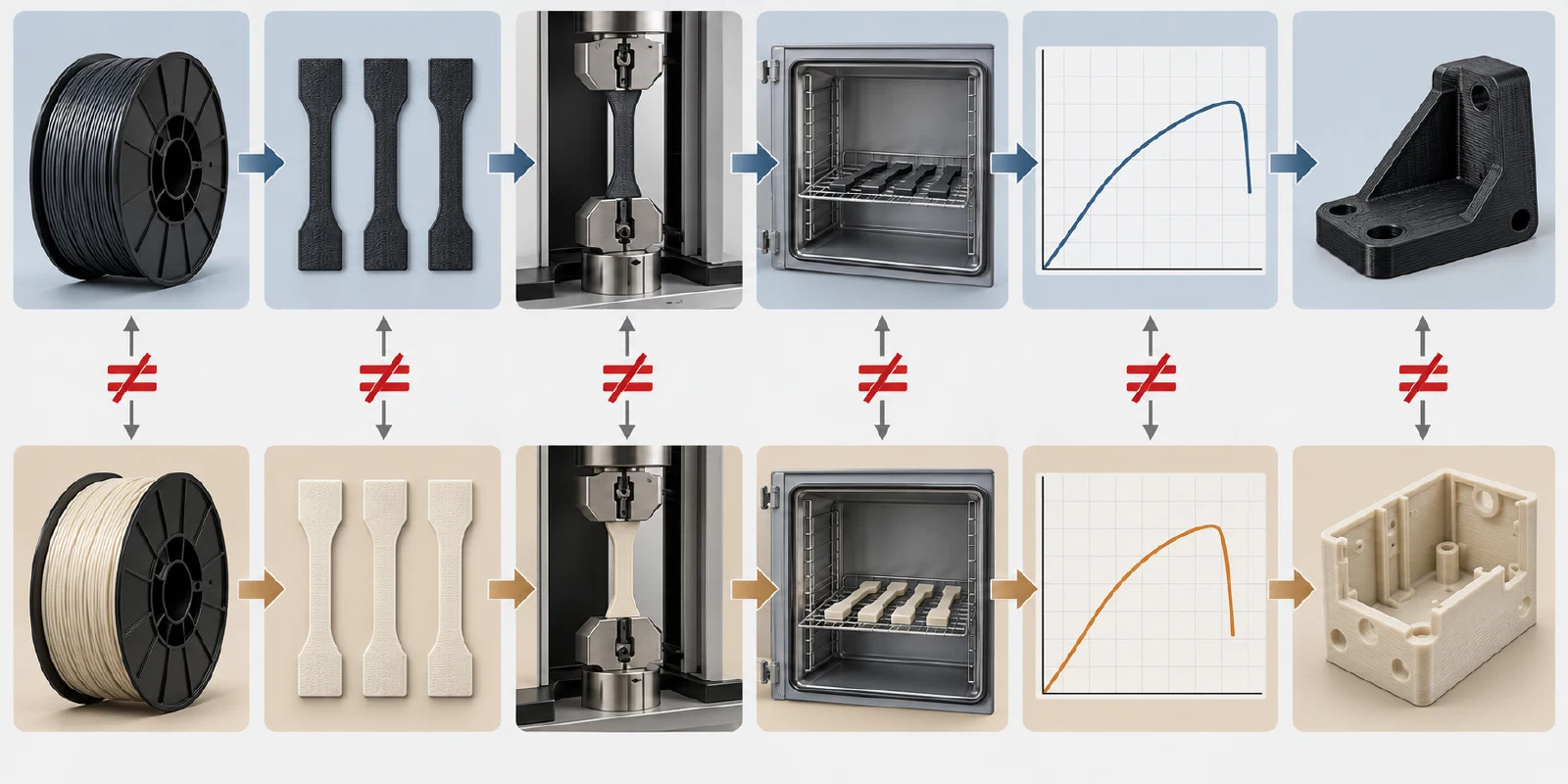
A material rating is not an end-part approval
Certification applies within the scope of the issuing program and evaluated material/process context. UL’s additive-manufacturing materials FAQ explains what its material certification covers; it is not an approval of an arbitrary user-designed part or its use. Check what the certification names and what it omits.
For ordinary hobby projects, use data to frame a question or compare candidate designs, then evaluate the actual part under a low-consequence, representative condition when appropriate. For structural, life-safety, medical, food-contact, regulated, or other high-consequence uses, this kind of comparison is not qualification.
Back to top ↑