An acoustic number is useful only when its measured quantity and setup are clear. Absorption, transmission loss, and sound-pressure level are different results; one cannot substitute for another.
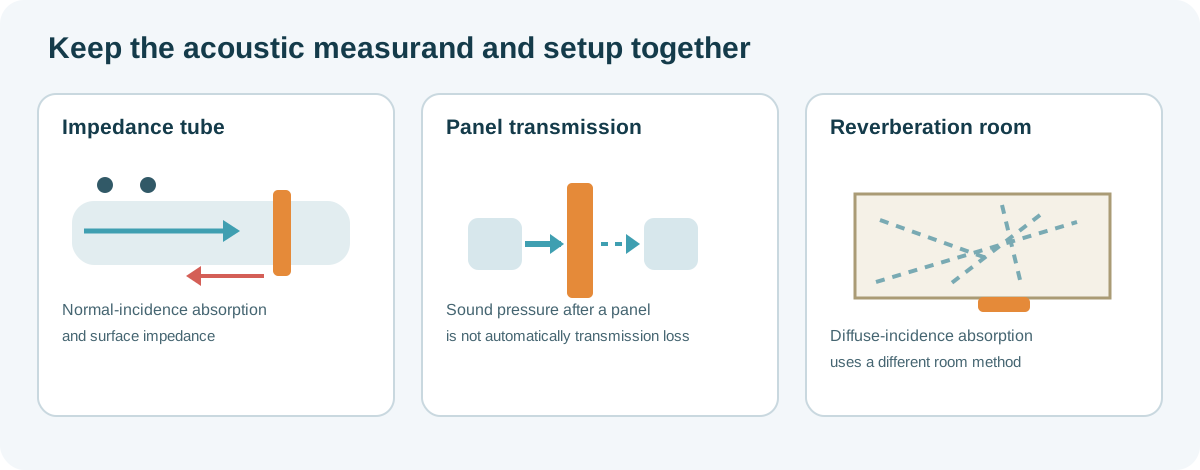
Check incidence and specimen arrangement
An impedance tube measures a sample under normal-incidence sound. ISO 10534-2 names absorption coefficient and surface impedance as outputs; its public abstract says these normal-incidence coefficients are not comparable to random-incidence coefficients measured in a reverberation room under ISO 354. The two methods ask different questions. Read the ISO scope .
ISO 354 describes measuring absorption in a reverberation room for materials and objects. A separate building rating has its own scope; a printed-panel study should not be described as a building rating unless that rating was actually established. Read the reverberation-room scope .
Transmission loss concerns sound passing through a partition. In one FFF PLA panel study, absorption and transmission results were reported for different constructions and fill values; they are not interchangeable. Another study measured pressure after sound passed through small polymer panels using its own source, receiver, and test arrangement. That response is not automatically a standardized transmission-loss result. Read the panel study and the small-panel study .
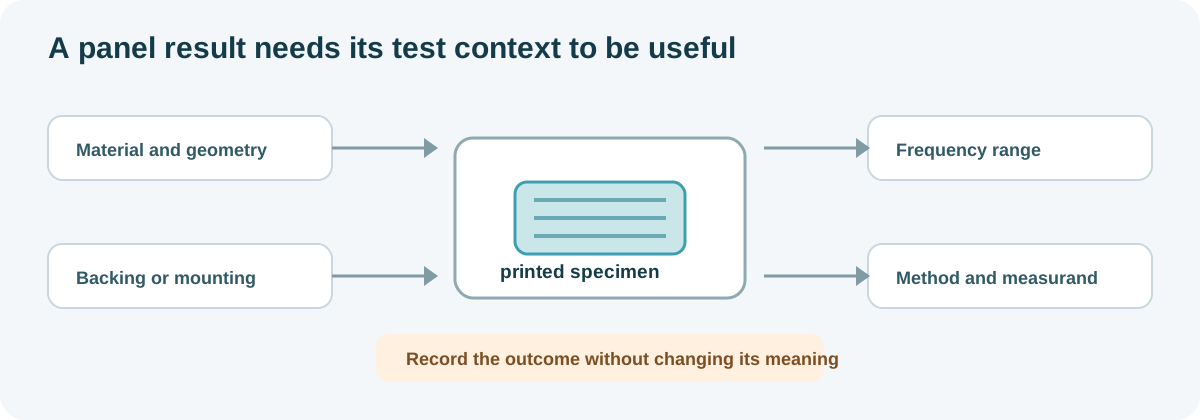
For a useful comparison, retain frequency range, specimen geometry, backing or mount, material, source and sensor positions, and test method. A coupon result does not establish installed room performance, a noise reduction at the listener, or a hearing-safety outcome.
Back to top ↑