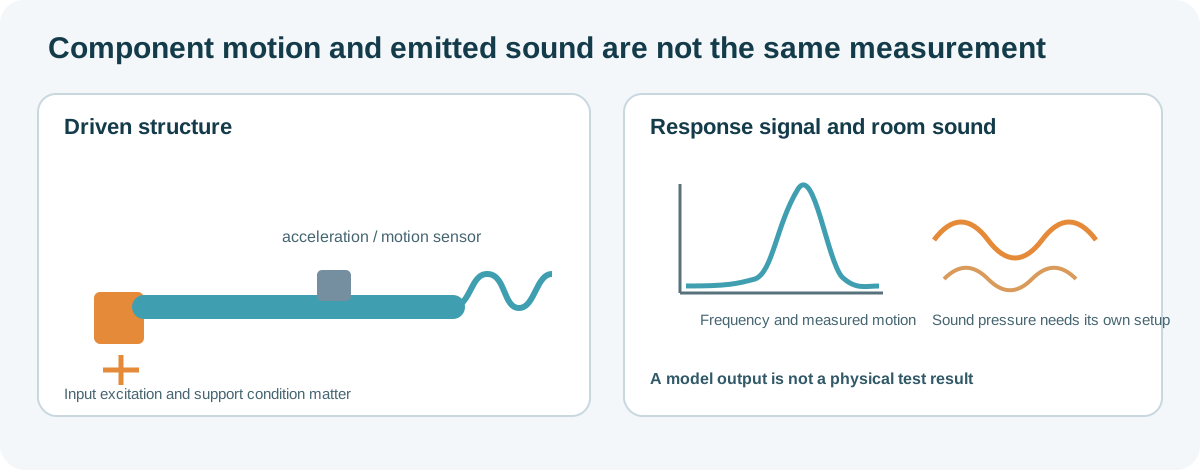
Vibration is movement of a part under changing force. A measured resonance or damping result describes that component and test; it is not the same as sound absorption in a room or a promise that an assembly will be quiet.
Identify the response and the structure
Studies of printed beams may measure motion near resonance and estimate damping. One FDM PLA study describes solid and lattice beams tested as cantilevers with base excitation, acceleration, and high-speed imaging. Its abstract reports a relationship between damping loss factor, void fraction, and flexural modulus but provides no transferable ranking or numerical design value. See the study abstract .
A separate PLA beam study examined tapered “acoustic black hole” terminations with experimental modal testing and simulation. The abstract reports reduced vibration over a stated band for its geometries, but does not provide a general material rating or print-setting recommendation. Read the institutional record .
Enclosure measurements add another layer: sound pressure depends on the enclosure, driver, microphone, room, position, and calibration. A comparative printed-enclosure study used one uncalibrated phone microphone, so it supports only its bounded relative comparison, not an absolute product result. Read the study .
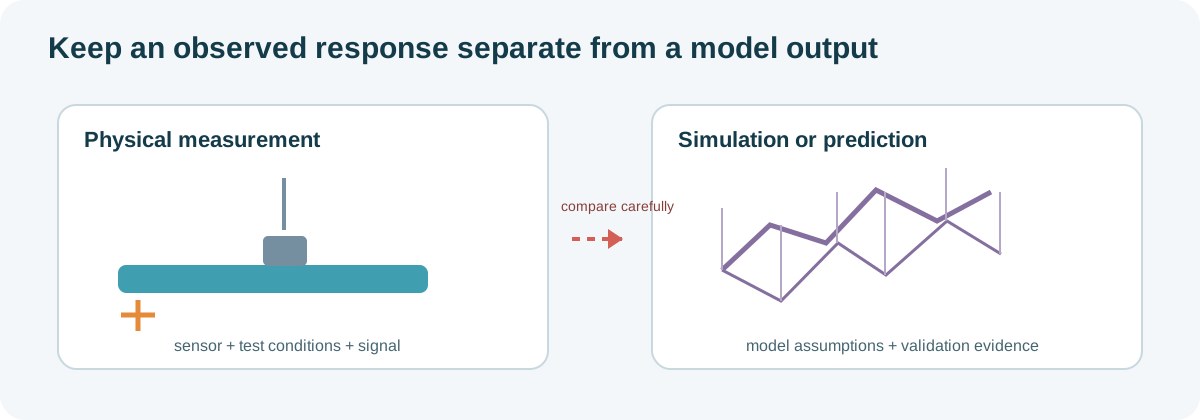
Record the excitation, support, specimen geometry, frequency range, sensor, processing method, and whether the result was measured or simulated. These studies establish no general vibration rating, fatigue life, room-noise reduction, or hearing-protection claim.
Back to top ↑