“Dry the nylon” can mean two different things: managing moisture in filament before printing, or changing the moisture state of a completed part. Those are not interchangeable tasks. A dry spool may help with print consistency; it does not describe the dimensions or properties of a part after it has absorbed moisture from its environment.
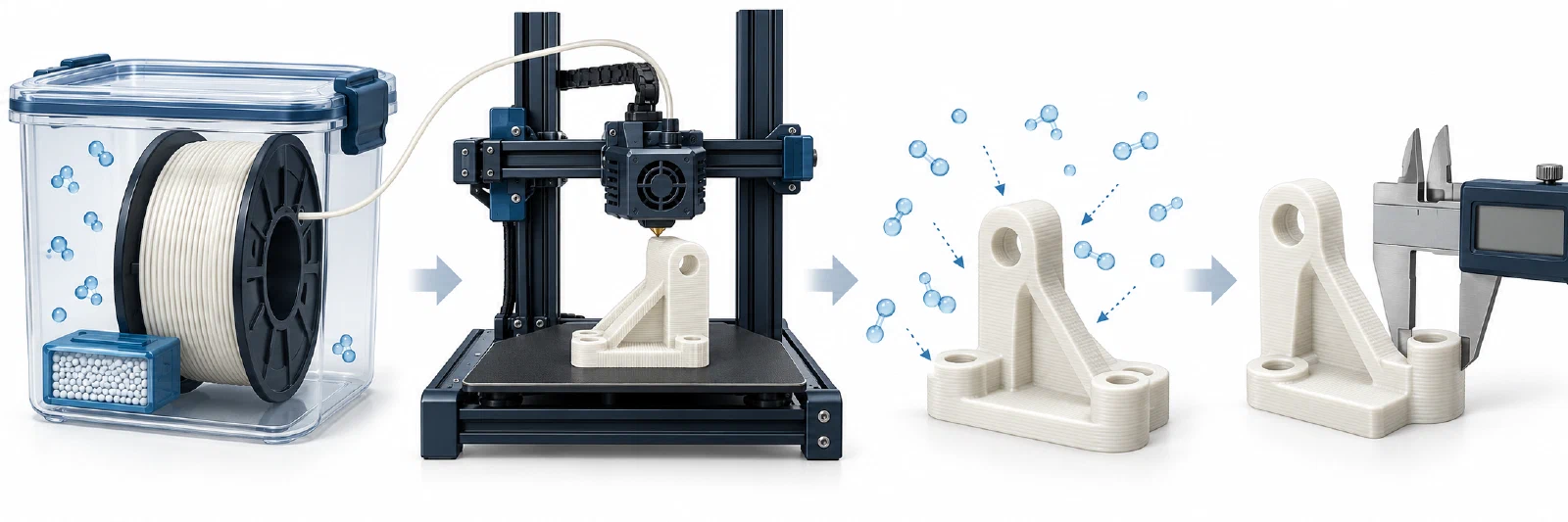
Spool state and part state are different
Moisture can affect polyamide filament and a printed nylon object at different stages. The Polymaker moisture-conditioning guide distinguishes filament handling from moisture uptake by the finished part and describes product-specific changes. Its statements are manufacturer guidance, not a universal target humidity, time, correction factor, or equilibrium condition for every nylon.
For a finished part, ask what state matters to the design. A feature may change dimension; stiffness or impact response may change; and the amount of change may depend on the nylon formulation, reinforcement, print structure, geometry, and exposure. “Nylon” alone is not enough to predict the result.
The measured feature matters
A Markforged-funded study of Onyx-based printed materials measured features in dry, controlled-humidity, and site-specific ambient states. The response varied by feature; reported short controlled-humidity dimensional changes were often below 0.5% and near measurement resolution. Those results are tied to the study’s proprietary material and system. They are not a universal correction for nylon holes, fits, or assemblies. Read the study .
Another study tested FFF polyamide specimens across humidity states and also included PA6GF. Its methods and results differ in their stated time to moisture saturation, so the record does not establish one general conditioning duration. It is a reminder to preserve the source’s exact material, state, and methods rather than turn one study into a schedule. See the study .
Water immersion is a separate exposure again. A study of printed nylon, composite nylon, and PLA in water measured uptake and flexural response under its own conditions. Immersion data do not define ambient conditioning or a normal room-humidity target. Read the immersion study .
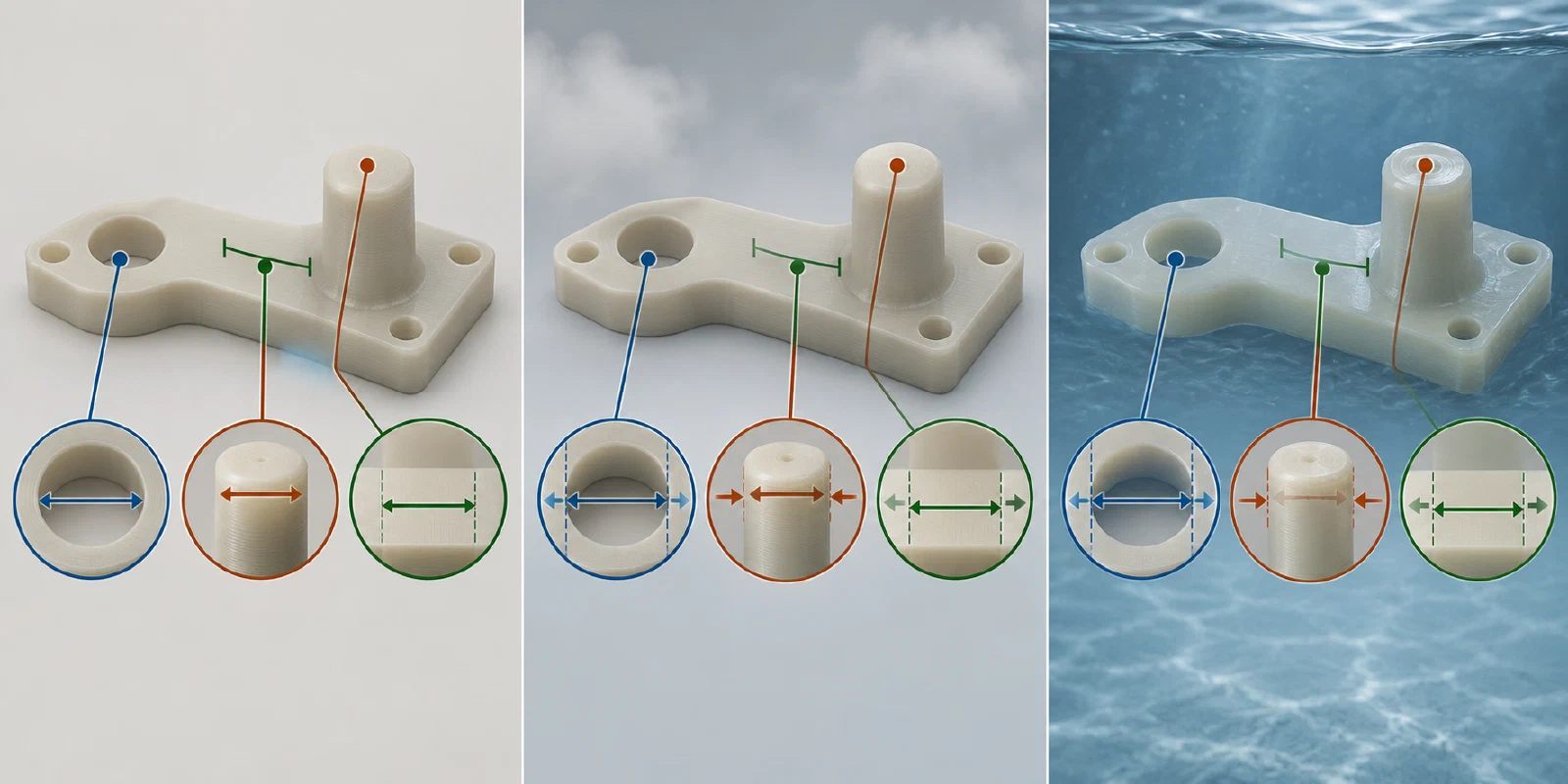
Plan around the state your part will actually see
For a non-critical part where a close fit matters, identify the exact product, feature, expected environment, and assembly state. Keep baseline dimensions and the condition in which they were measured. If you compare parts or test a fit, compare the same features in clearly described states; do not apply a generic expansion allowance from another material or geometry.
When reading a source, look for the relative humidity or exposure medium, temperature, duration, specimen geometry, mass or dimensional endpoint, and whether mechanical properties were measured. If the source reports only mass gain, it does not prove a particular dimensional change or strength change. If it reports a small feature change near instrument resolution, it may not support a precise correction.
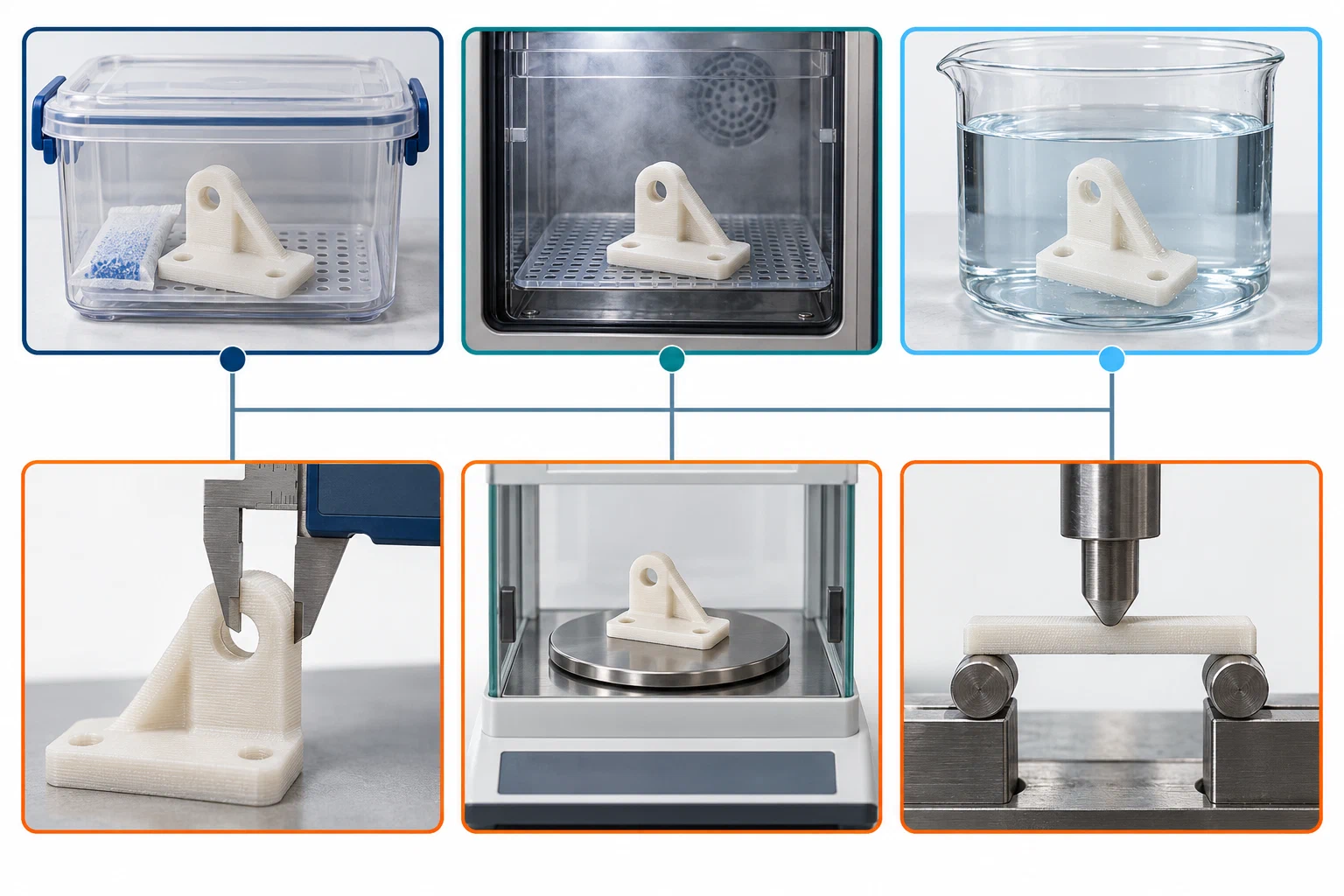
What remains uncertain
The available evidence does not establish a universal nylon moisture target, equilibrium time, dimensional correction, or property adjustment for arbitrary printed parts. Manufacturer product instructions may help identify the intended material state, but they do not replace measurement and qualification of a consequential assembly.
Use How to Read FFF Part-Performance Data when comparing conditioned results. For structural, life-safety, medical, food-contact, or regulated uses, this guide does not qualify the part.
Back to top ↑