A hinge that releases and moves once has not demonstrated how it behaves after repeated movement. A simulated cycle count is not the same result as a physical fatigue test.
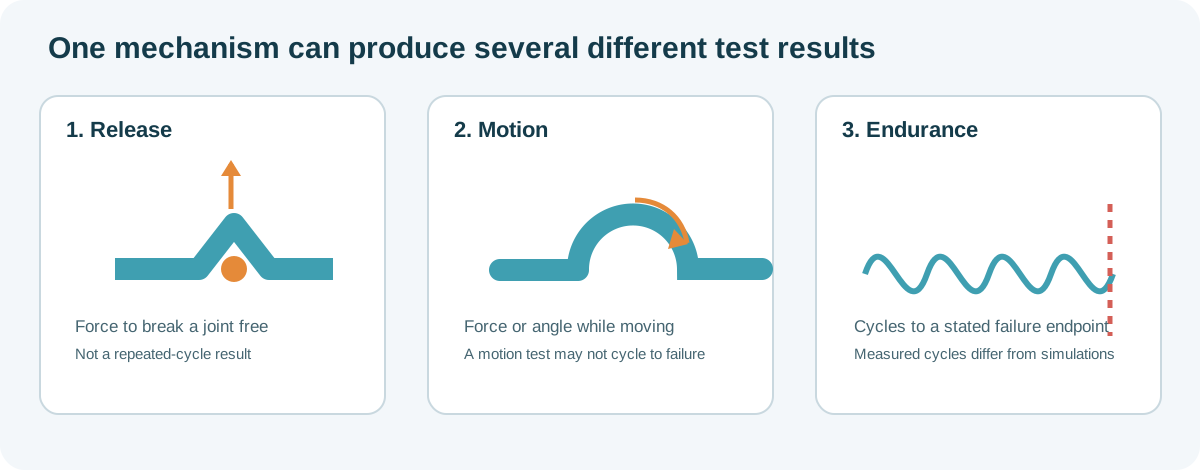
Identify what the study measured
Print-in-place hinge studies may measure the force needed to break the joint free or keep it moving. In one study, smaller gaps raised release and motion forces and could cause fusion; orientation also affected the tested results. Those observations apply to the tested geometries and farm printers, not a universal clearance or durability rule. Read the study .
Other work measures how many folds a functional hinge specimen completes before a defined failure. A publisher abstract reports different outcomes across seven thermoplastic families, but does not expose enough of the protocol to rank those results against other studies. A cycle count is not a service-life estimate for a user part. See the hinge study .
Separate measured loads from model outputs. A printed gripper paper reports physical closing-force measurements, then analyzes fatigue with finite-element software. Its methods do not describe a physical cycling-to-failure test, so its simulated cycle values must not be reported as observed endurance. Read the article .
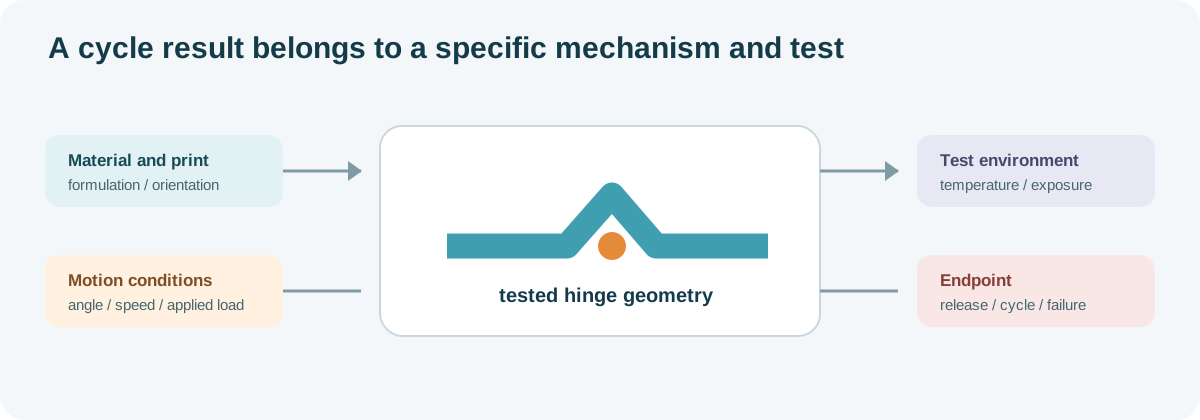
For any comparison, record hinge geometry, material, print orientation, loading path, fold angle, speed, environment, replicate count, and the failure definition. Initial release, motion force, peak force, physical fold cycles, and predicted cycles answer different questions.
No cited result supplies a general hinge design, safe load, clearance setting, or lifetime. These examples support careful interpretation of non-critical printed mechanisms only.
Back to top ↑