Assembly choice depends on the exact materials, geometry, access, fit, and whether you may need to take the part apart. A joint that holds a decorative shell together is not automatically suitable for a repeated load, warm environment, or consequence-bearing use. Treat every assembly as a material pair and a design question, not a search for one “best glue.”
Compare the assembly options
| Approach | Useful when | Evidence to check | Questions that remain |
|---|---|---|---|
| Adhesive | You can prepare and reach the surfaces and do not need routine disassembly | Exact adhesive, printed polymer, surface state, gap, cure conditions, and test mode | Compatibility and strength may change with geometry, environment, and preparation |
| Screws or other fasteners | You need a removable joint or can design a bearing feature | Fastener dimensions, printed feature geometry, orientation, and repeated-use behavior | A catalog fastener rating does not rate the printed boss or whole assembly |
| Heat-set insert | A reusable threaded feature fits the design and material | Insert model, tool guidance, host material, local geometry, and evidence for the finished feature | Tool alignment guidance is not a pull-out or torque rating for your part |
| Co-printed interface | The machine and materials can deposit the planned combination | Exact material pair, machine configuration, interface geometry, and measured interface result | Declared material compatibility is not a measured bond or durability result |
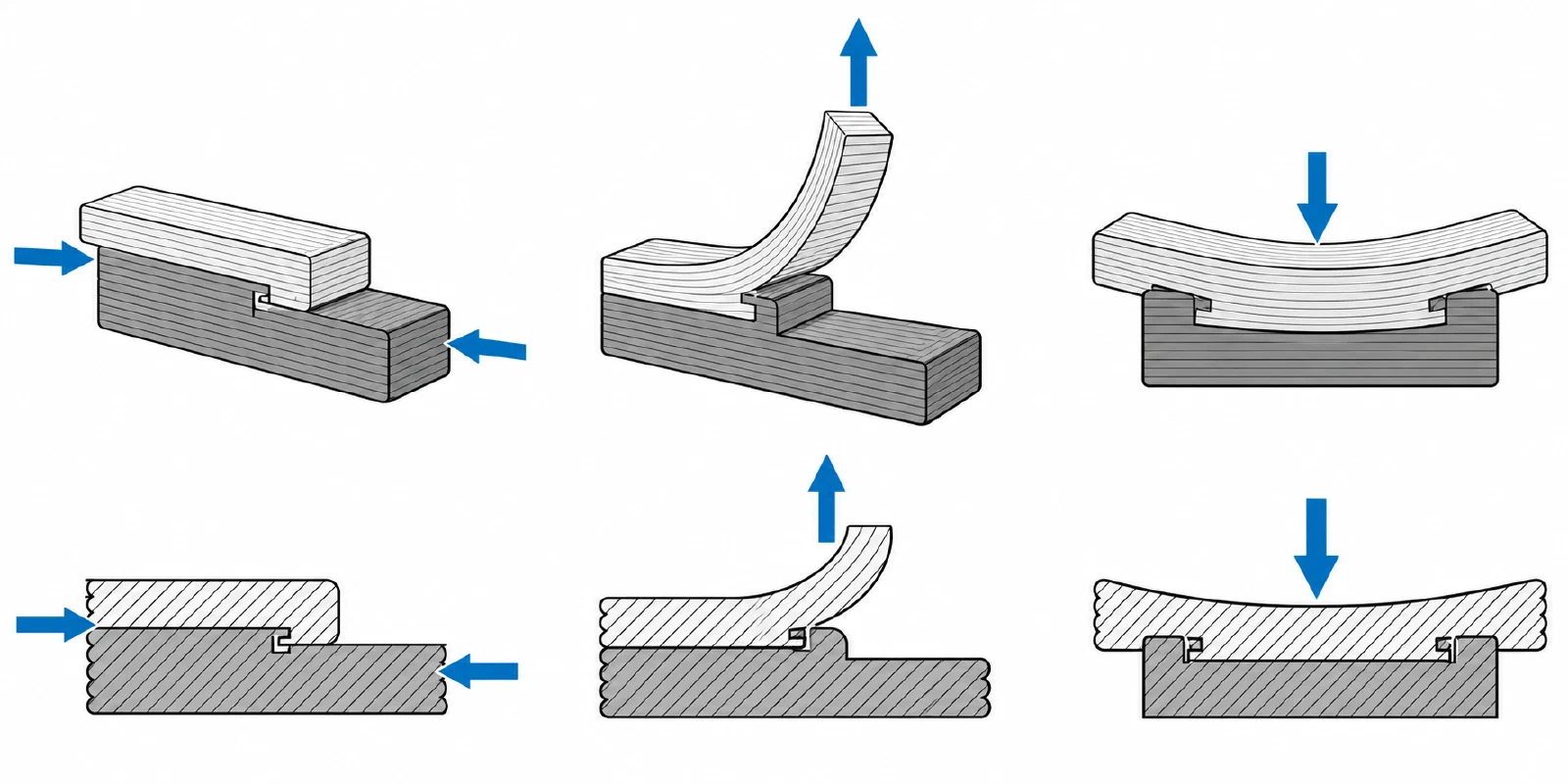
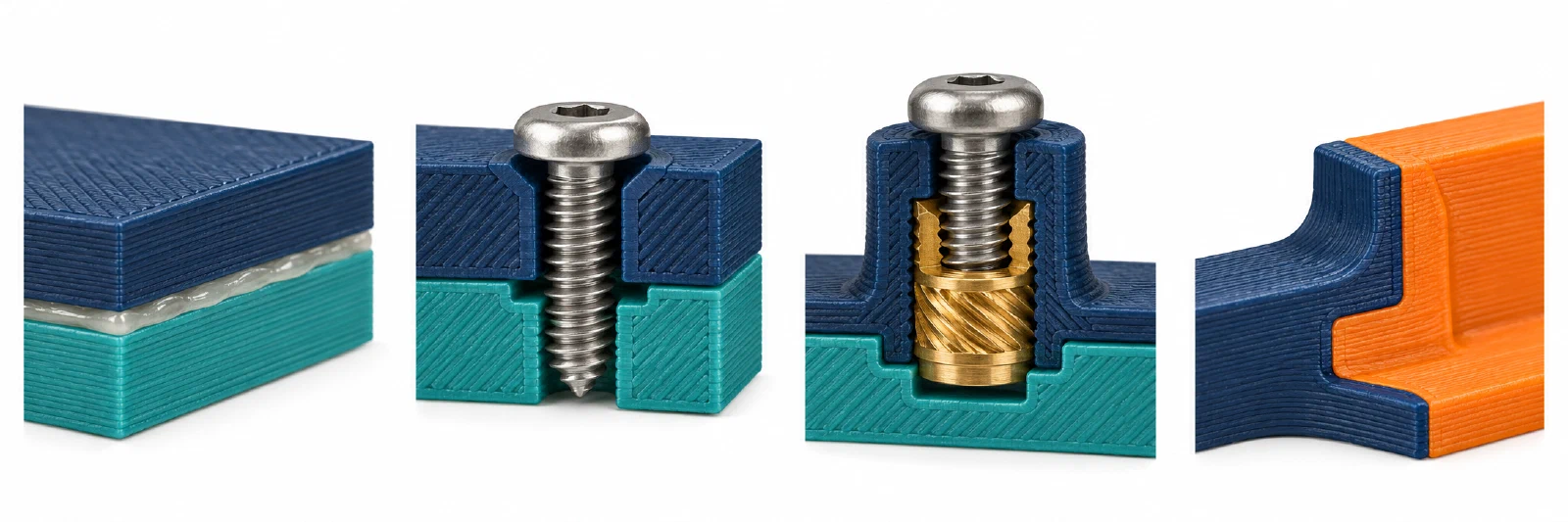
These options solve different problems. A removable screw may be preferable even if an adhesive could hold, while an adhesive may avoid a bulky boss. Material choice alone cannot settle fit, assembly access, repairability, or how the joint will be loaded.
Read adhesive claims narrowly
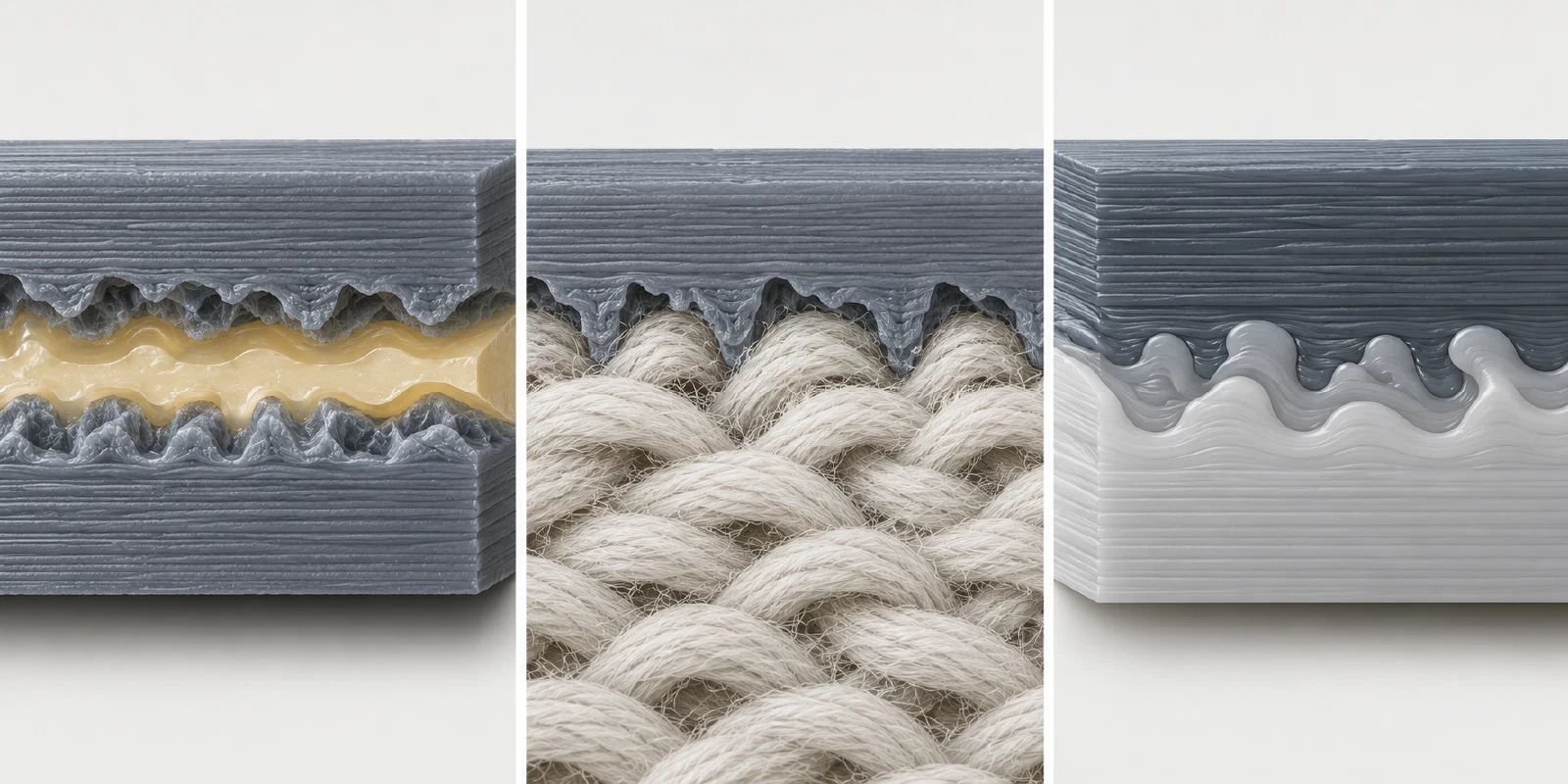
A description such as “bonds plastics” does not establish performance on a particular filament surface. The 3M DP100 Plus Clear technical sheet gives product-specific test and cure information, but it is not a test of a named FFF filament, printed surface, or joint geometry. Its current U.S. product page identifies industrial/occupational use; it is not a recommendation for a consumer FFF assembly.
When evaluating any adhesive, separate work time, handling strength, a defined test threshold, and stated cure time. They are different endpoints. Then check whether the documentation names your substrate and use conditions. If not, the printed-part compatibility remains unverified.
Inserts and mechanical fasteners need part-specific evidence
An insert product guide can describe an insert or tool without qualifying the printed feature around it. LDO’s heat-set insert tool guide gives qualitative alignment and heating guidance for its tool, but does not provide a general material matrix, a host-material temperature setting, or joint performance. Prusa’s listing for CNC Kitchen inserts gives product guidance, yet its two temperature-offset statements differ. That disagreement is a reason to check the current exact product instructions, not to choose one number for every part.
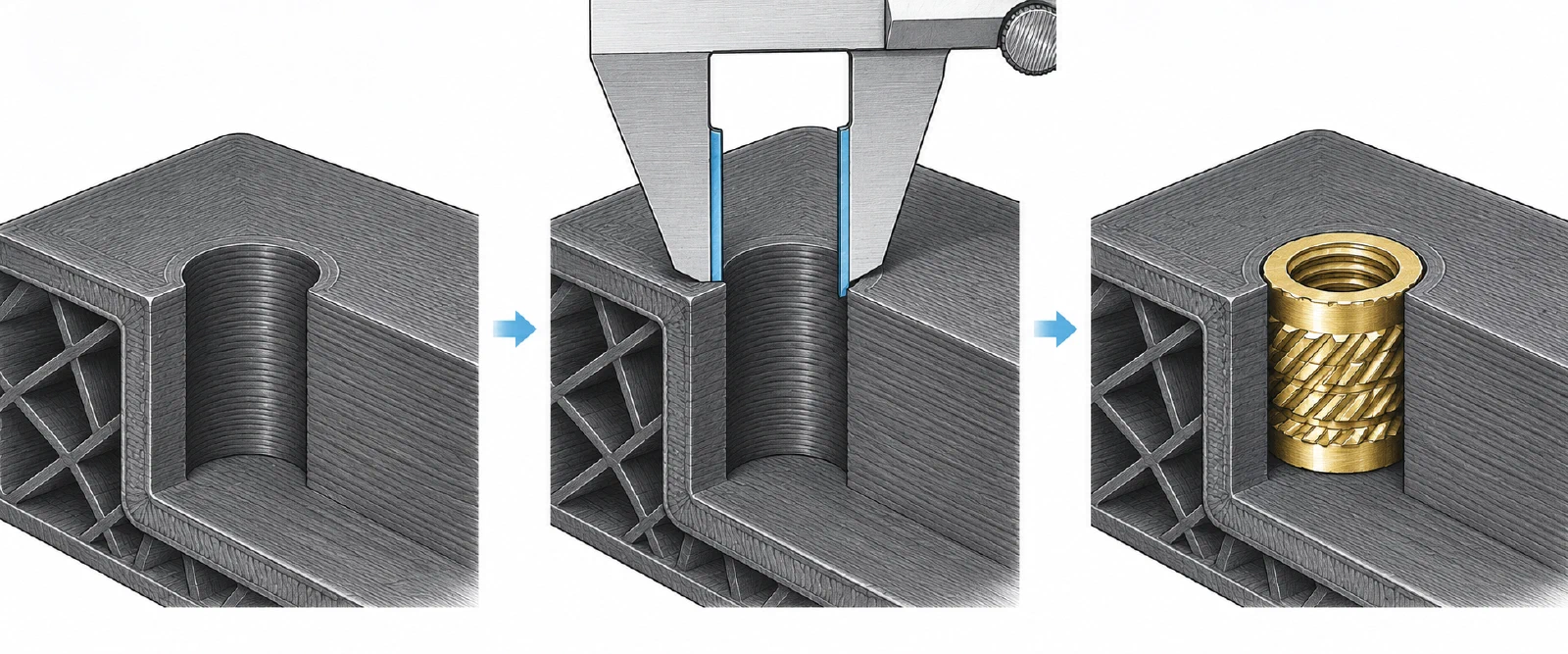
For a fastener feature, consider the load direction, wall and boss geometry, distance to an edge, print orientation, access for assembly, and whether repeated removal matters. These are design variables; a fastener’s metal rating does not describe the printed material surrounding it. The guides above are not a substitute for an application-specific structural evaluation.
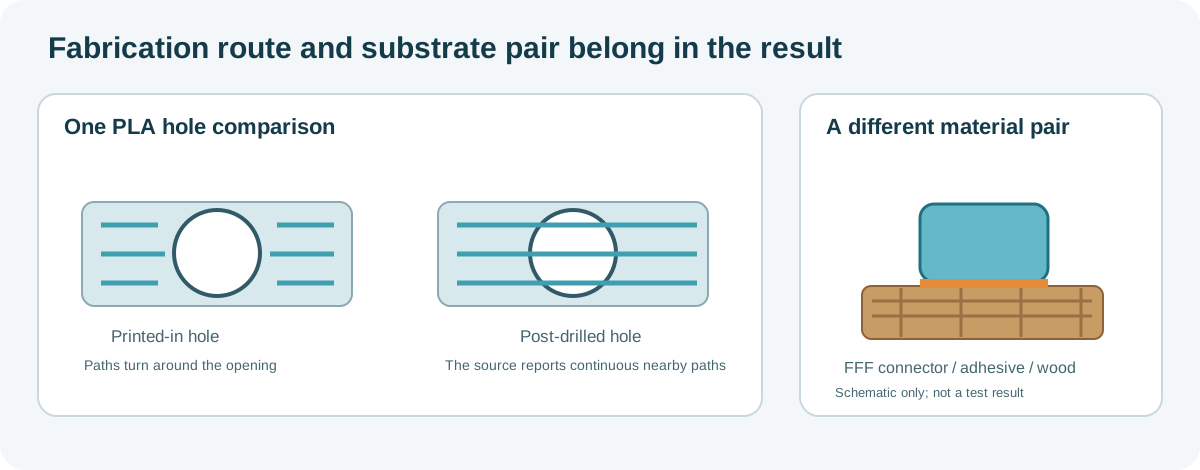
Hole fabrication itself can affect the specimen. A 2026 study compared five FFF PLA tensile specimens with a 6 mm hole printed in place against five drilled after printing, under one 0° raster and full-infill setup. Its reported mean tensile strengths were higher for the drilled specimens. Microscopy also showed different path continuity around the holes. This is one material, geometry, and test configuration; it is not a drilling recommendation, a general strength difference, or a fastener-hole rating. Read the study .
Wood-to-printed joints are a separate material pair
A 2026 study tested FFF modified PLA+ connectors bonded to Scots pine with two named adhesives and sanded or unsanded surfaces. Its small groups showed different tensile adhesion results by adhesive and preparation; bending outcomes also depended on the loading arrangement. These measurements apply to that connector, PLA+ product, wood batch, and test setup. They do not rank adhesive families, establish a consumer bonding procedure, or provide a design allowable. Read the study .
Separate joining from co-printing
Co-printing two materials creates an interface during deposition. It is distinct from applying an adhesive after printing, inserting hardware, or merely showing that two filaments can be loaded by a machine. The evidence needed is a measured interface made with the actual material pair and relevant geometry.
Prusa’s assembly overview is helpful for seeing the range of options, but its practical examples do not establish universal FFF joint strengths.
Research routes beyond adhesives and fasteners
Research has also examined post-print welding of FFF parts, including friction-stir, ultrasonic spot, and linear-friction approaches. The available records are limited to named specimens and specialized equipment; one is abstract-level and another is a thesis abstract. They do not establish a hobby-scale method, task controls, joint durability, or an allowable load. A separate study used printed thermoplastics as heated adhesive layers between steel adherends with induction equipment. Its shear, tensile, and bending results differ by loading mode and do not describe polymer-to-polymer assembly. These are evidence topics to investigate, not procedures or recommendations. (friction-stir study ; ultrasonic-welding conference paper ; linear-friction-welding thesis abstract ; thermoplastic adhesive-layer study ).
Keep a comparison before committing
For a non-critical assembly, record the exact material products and surface state, joint design, fastener or adhesive identity, assembly conditions, intended environment, and what the test did and did not measure. If you make a small trial, keep it representative of the planned geometry and use the exact current product directions. A successful hand check is an observation, not a load rating or durability guarantee.
For structural, life-safety, medical, food-contact, or regulated assemblies, this category does not provide qualification or approval.
Back to top ↑