Two materials being printable on the same machine does not show that the completed interface is strong or durable. A manufacturer’s compatibility statement, a successful material transition, and a measured mechanical interface are three different kinds of evidence.
What “compatible” could mean
Compatibility may refer to feeder handling, tool or temperature settings, successful material changes, or a manufacturer’s recommendation to combine two product families. Those claims can help decide what to investigate, but they do not establish the performance of a particular joint.
A measured interface result needs more context: exact material products, printer and deposition process, interface geometry, orientation, test method, comparator, and failure mode. A tensile result for one geometry does not necessarily predict bending, peeling, impact, cyclic loading, or durability after environmental exposure.
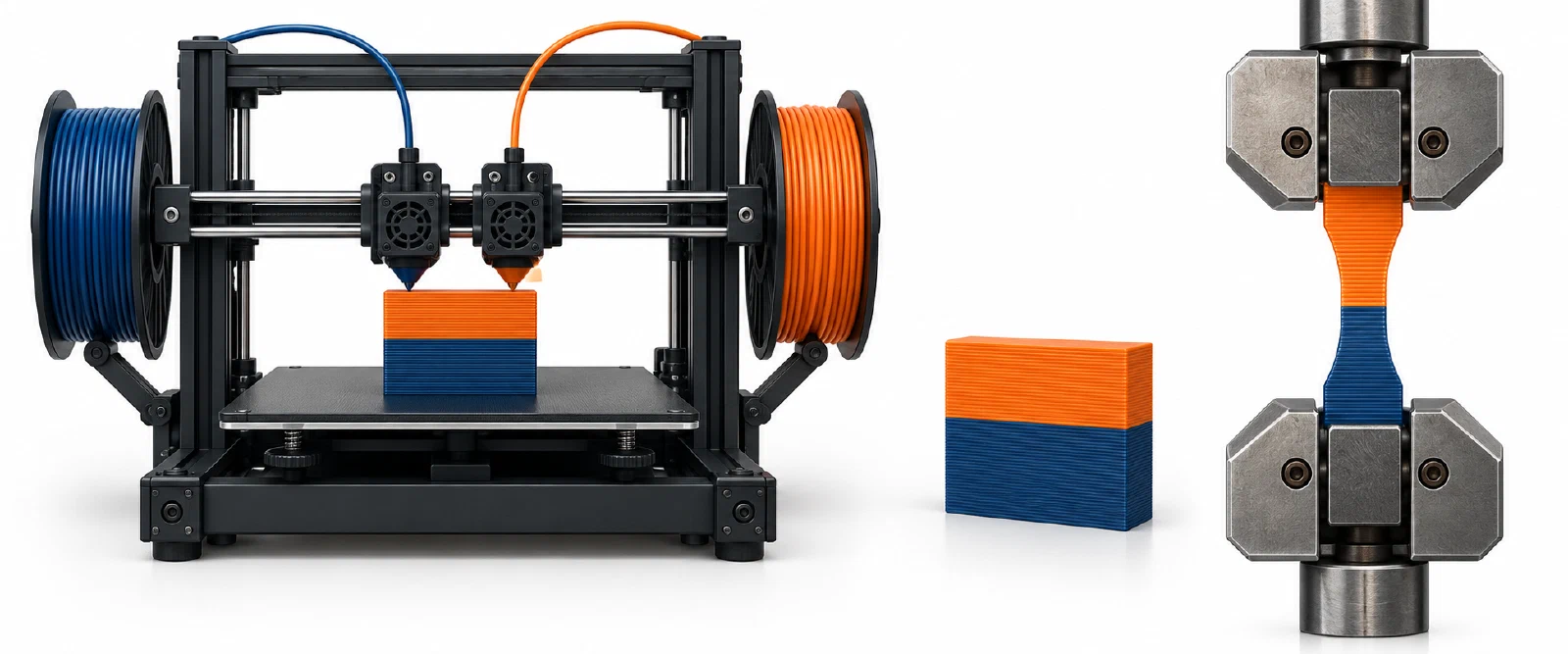
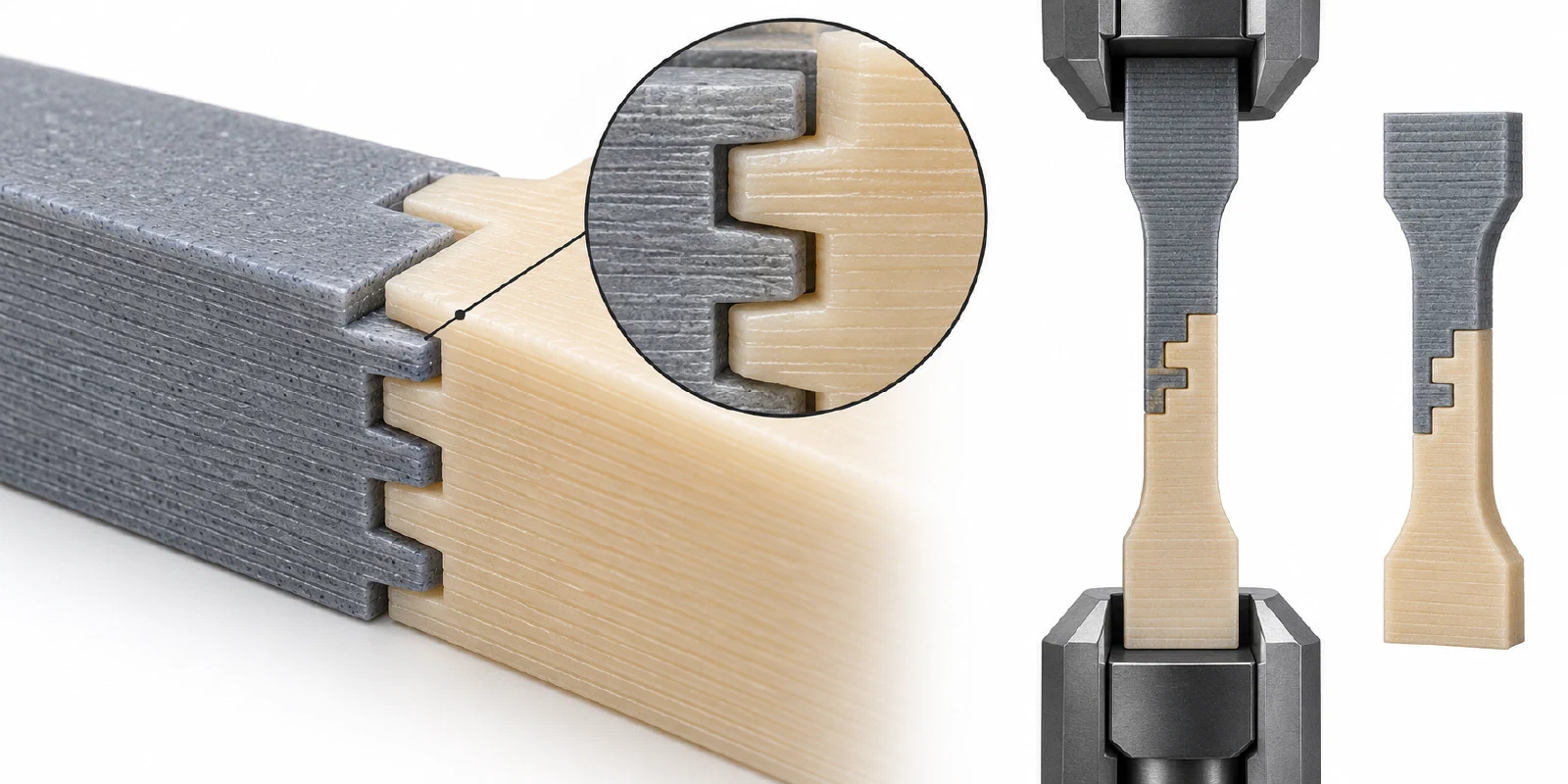
Read each source within its own pair and test
One study measured FFF PETG/TPU interfaces using a particular printer and several interface designs. It showed that outcomes varied with the tested geometry and loading method. That is evidence that interface design matters for that material pair and setup; it is not a general strength value for PETG/TPU or a transfer rule for other combinations. Read the PETG/TPU study .
Polymaker’s Fiberon PET-CF17 page describes PET-CF17/PETG compatibility in qualitative terms and calls for application-specific validation. It does not report a measured interface test or bond-strength result. A compatibility statement is not a quantitative performance claim.
Compare an interface with the right alternative
If you are deciding between co-printing, adhesive bonding, and fasteners, compare the actual job each method must do. A fastener can be removable; an adhesive may require surface preparation and cure time; a co-printed interface depends on the material pair and deposition geometry. The assembly overview from Prusa illustrates available approaches but does not supply universal FFF joint ratings.
For a non-critical decorative part, keep a record of the product pair, interface layout, print conditions, and exact test or observation. A fit check or manual handling observation can identify an obvious issue; it is not a load rating, fatigue test, or durability qualification.
The currently available evidence does not establish a broad compatibility matrix, a ranking across material pairs, or application approval. For high-consequence or structural uses, seek appropriate qualification for the finished design.
Back to top ↑