A chemical-resistance label is only useful when its scope matches the actual chemical, concentration, temperature, contact time, printed material, and part state. A broad polymer name or a “good” rating does not tell you whether a particular filament product or finished part is suitable for a specific liquid.
Read the whole exposure description
When a study reports chemical exposure, look for:
- the exact filament formulation and printed specimen process;
- the chemical identity, concentration, and exposure medium;
- temperature, duration, and whether exposure is continuous or intermittent;
- specimen geometry, orientation, and conditioning;
- the measurement before and after exposure, including the test method;
- the number of specimens, variation, and reported failure mode.
Mass change, visible appearance, tensile result, impact response, and dimensional change answer different questions. A study that measures one does not automatically establish the others.
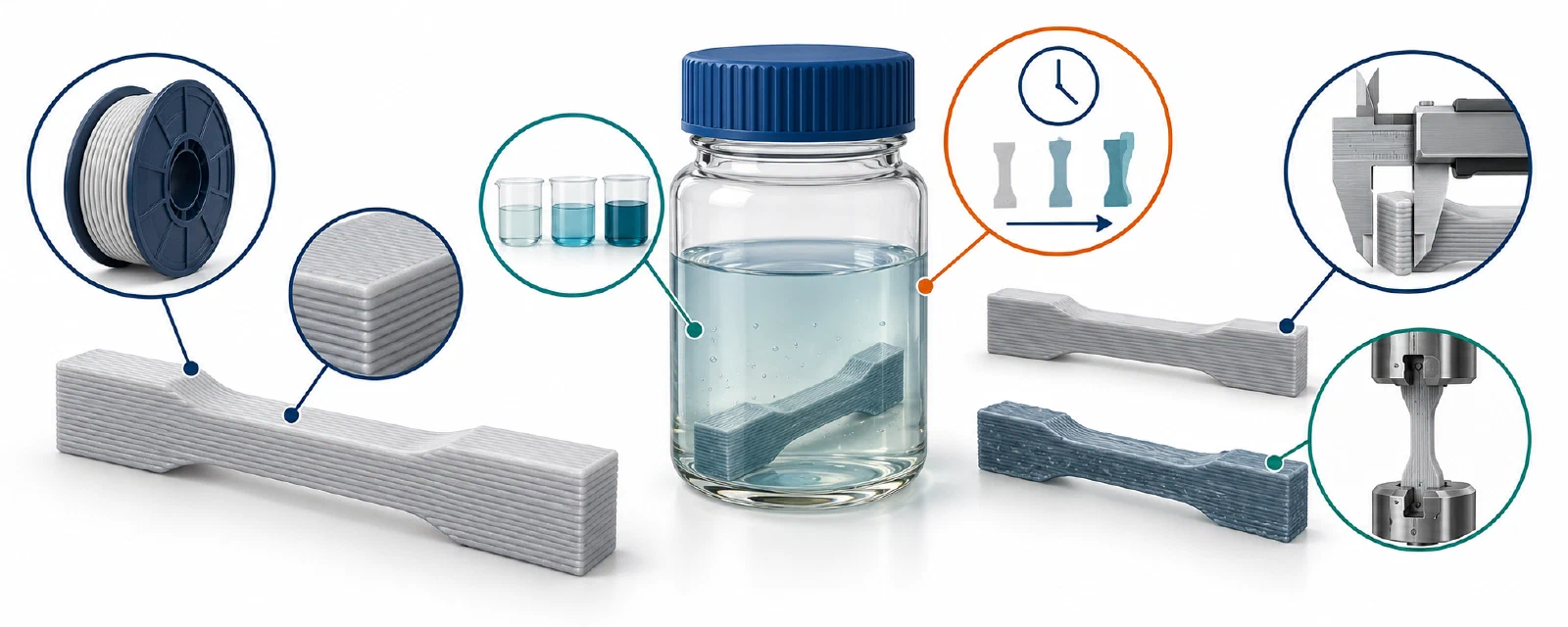
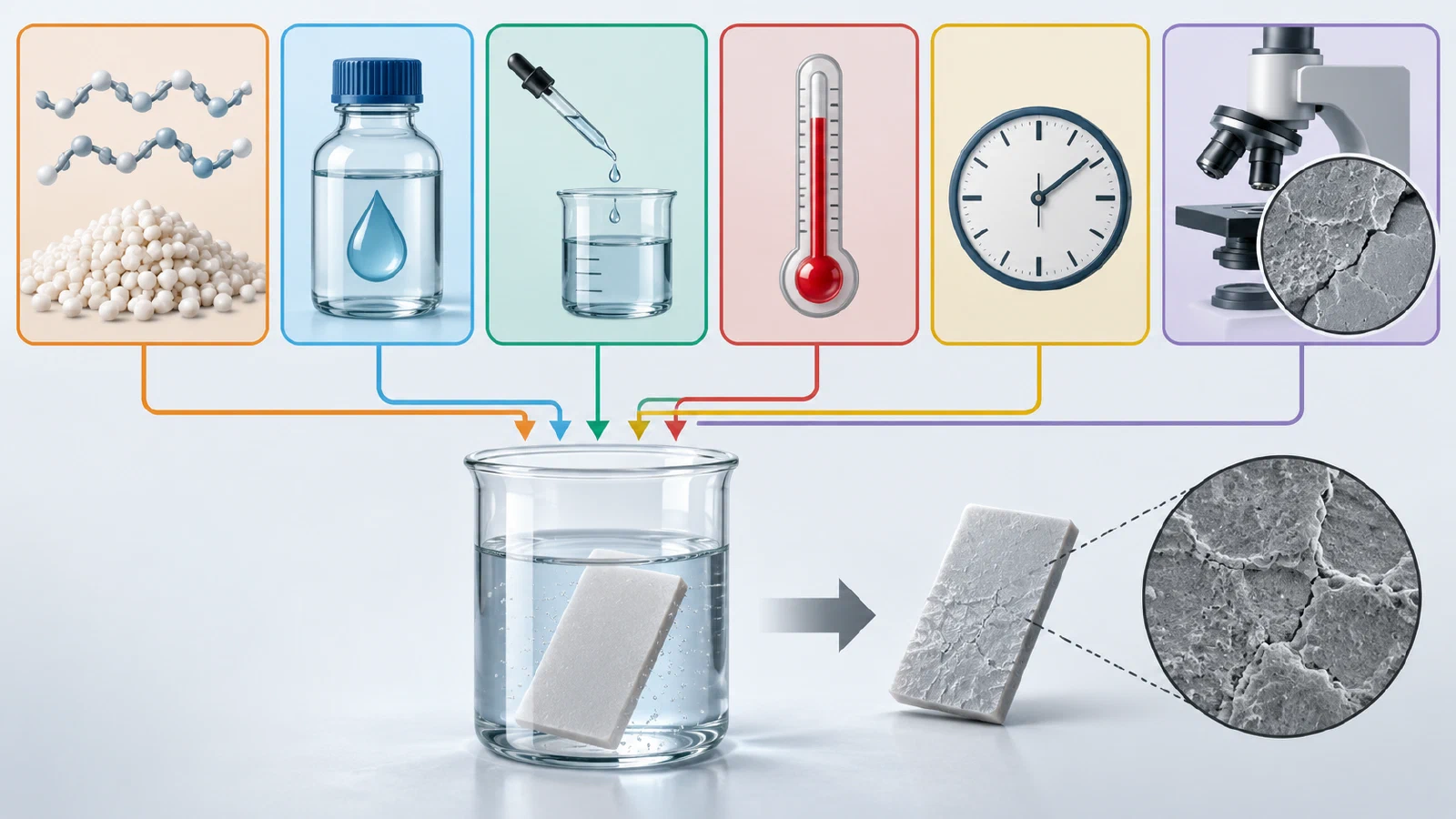
An eight-product study of printed filaments illustrates why a table of “compatible” and “incompatible” materials can be misleading. The paper’s methods and results contain unresolved differences in the stated impact-test apparatus, liquid volume, number of coded liquids, and one polypropylene retention summary. Those conflicts limit how confidently the results can be compared or converted into advice. The study is evidence about its own samples and procedures, not a general compatibility standard. Read the study .
Manufacturer classes are not a printed-part test
A manufacturer datasheet can provide useful product-specific direction, but check what it actually reports. The Polymaker PETG technical sheet lists qualitative chemical-resistance classes and a moisture curve. It does not identify exact chemical concentrations and exposure methods for every listed class or establish a compatibility result for a printed part.
Similarly, an immersion study with selected printed PLA and PETG measured mass, dimensions, and visible change in particular water-based media, but called for additional mechanical testing. It did not establish water-tightness or suitability for a different liquid, filament brand, or part geometry. See the study .
Cleaning and chemical exposure are different decisions
A product may be appropriate for cleaning one surface under its label directions without being suitable for prolonged contact or for a load-bearing joint. Follow the current label and safety information for any cleaner or coating you choose. Do not use a general polymer statement, an unrelated laboratory solution, or a coating study as approval for food contact, skin contact, medical use, or an outdoor service environment.
If the exact material/chemical combination and intended exposure are not documented, record it as unknown. A small test can reveal an obvious cosmetic issue for a non-critical project, but it does not establish chemical compatibility, long-term retention, or safe use.
For other comparison questions, see How to Read FFF Part-Performance Data . The available evidence does not support a universal chemical-resistance chart or a household exposure recipe.
Back to top ↑