Finishing work begins after a part leaves the printer and may move to a different table, tool, chemical, or heat source. The printer’s enclosure, filter, or room plan does not automatically control that second task. This guide helps you prepare a task review; it is not a sanding, coating, adhesive, or thermal-treatment recipe, and it does not approve a particular workstation.
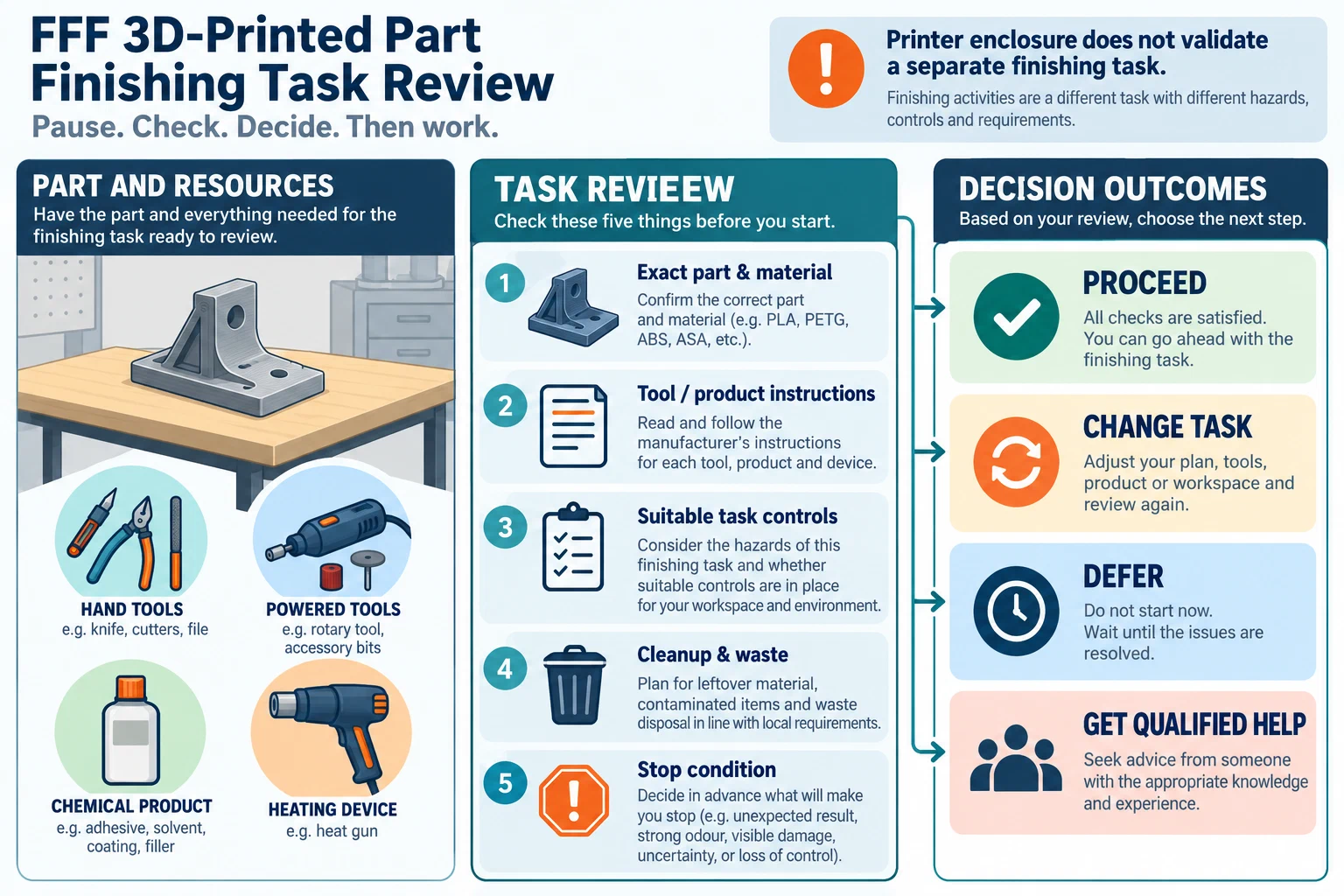
Identify the task before choosing controls
Write down the part’s material, product and additives; the finish or assembly goal; each hand or powered tool; every chemical or coating product; any heating device; the room and nearby occupants; and the person responsible for the work. Check the current manufacturer instructions for the part material, tool, device, and each product. A filament safety sheet does not cover an adhesive or coating that is added later.
Ask whether the step is needed for the intended non-critical use. If a simpler process or a different part design avoids unnecessary cutting, dust, chemical use, or heat, consider that option before selecting protective equipment. Keep printer operation, routine plate release, and a separate finishing workstation as different tasks with their own instructions and controls.
For each task, record what it can release or create, the control and handling instructions that apply, compatible cleanup and waste steps, and the condition that means work must stop. Check protective equipment against the exact tool instructions and product label or safety data sheet; a generic glove or respirator choice cannot fill an evidence gap.
Match the control review to the task
| Task | Confirm before starting |
|---|---|
| Support trimming or hand-tool work after plate release | Follow the exact printer, plate, part, and tool instructions. Make sure the part and work surface can be held as those instructions require. Stop if the work needs excessive force, the part is not secure, or the tool is damaged or unsuitable. Routine plate release remains covered by the hot-surface and workshop checklist . |
| Sanding, cutting, or grinding | Identify the material and any filler, the tool’s guards and operating instructions, how dust will be captured and cleaned, and whether the control is intended for this task. NIOSH lists ventilated enclosures or downdraft tables as workplace control options for cutting or grinding; that example does not certify a consumer device or a particular setup. |
| Adhesive, filler, coating, cleaner, or spray | Read the current label and safety data sheet for the exact product and region. Check its application, ventilation, ignition, incompatible-material, storage, cleanup, and waste instructions. Do not borrow another product’s glove, respirator, or disposal advice. |
| Heat-assisted assembly or material treatment | Check the exact material maker’s process guidance and the heating device’s instructions, including where it may be used, temperature control, supervision, cooling, and cleanup. A material treatment page does not approve a shared food oven or improvised heater. |
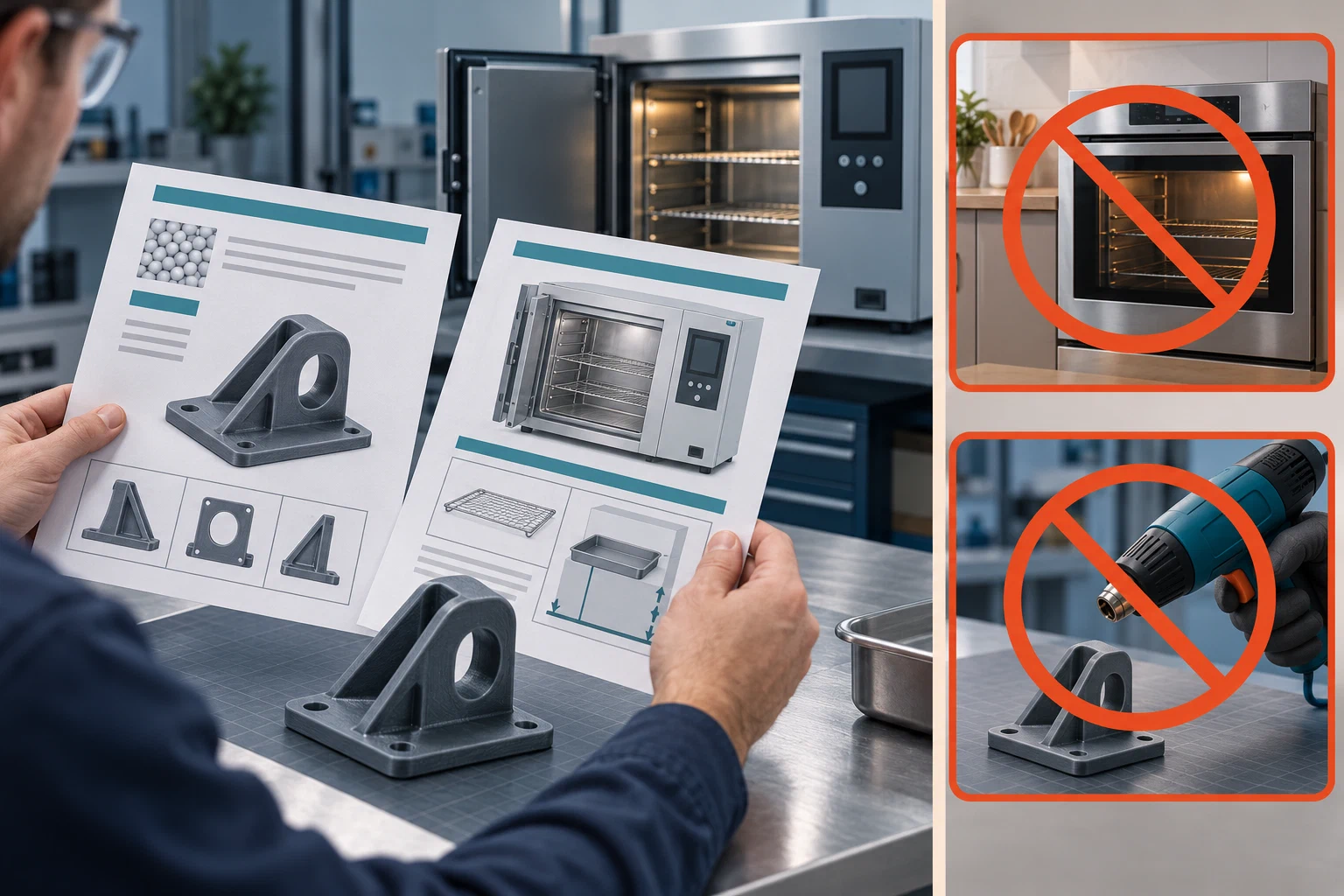
The crossed-out examples illustrate a missing approval check, not a universal ban: confirm the intended device and work area against the exact product and equipment instructions.
The National Institute for Occupational Safety and Health (NIOSH) includes post-processing, maintenance, and cleaning in its risk-management guidance for non-industrial printing workplaces. It recommends considering removal or substitution and engineering controls before relying on administrative measures or personal protective equipment. The guide gives examples for chemical finishing and cutting or grinding, but it does not provide a universal dust extractor, ventilation rate, chemical procedure, or protective-equipment choice. See the NIOSH safe-printing guide for its scope and control examples.

Decide whether to proceed
Before work starts, make sure the task has a source for each important decision: product and equipment instructions, the relevant workplace or local requirements, a suitable control for the material generated, and a known cleanup, waste, and response path. In a school, library, or makerspace, follow the facility’s approval, training, access, and waste procedures; another institution’s rule is not a household default.
Proceed only when those instructions and controls match the actual task and the responsible person can manage an interruption or failure. Change the task when an unnecessary step or a lower-hazard alternative meets the same purpose. Defer the work when product identity, chemical directions, equipment suitability, dust or vapor control, cleanup, or waste handling remains unknown. Seek qualified help for ventilation design, electrical work, regulated materials, or other decisions outside the tool or product instructions. Personal protective equipment is task-specific and does not replace a suitable control plan.
For the printer, room, and material decisions, use ventilation and local controls , material-specific handling and emissions context , and hot surfaces, electricity, fire, and housekeeping . A specific finishing procedure, material treatment, or measured property belongs in Part Performance & Post-Processing . None of these checks certifies a part for structural, food-contact, medical, or life-safety use.
Back to top ↑