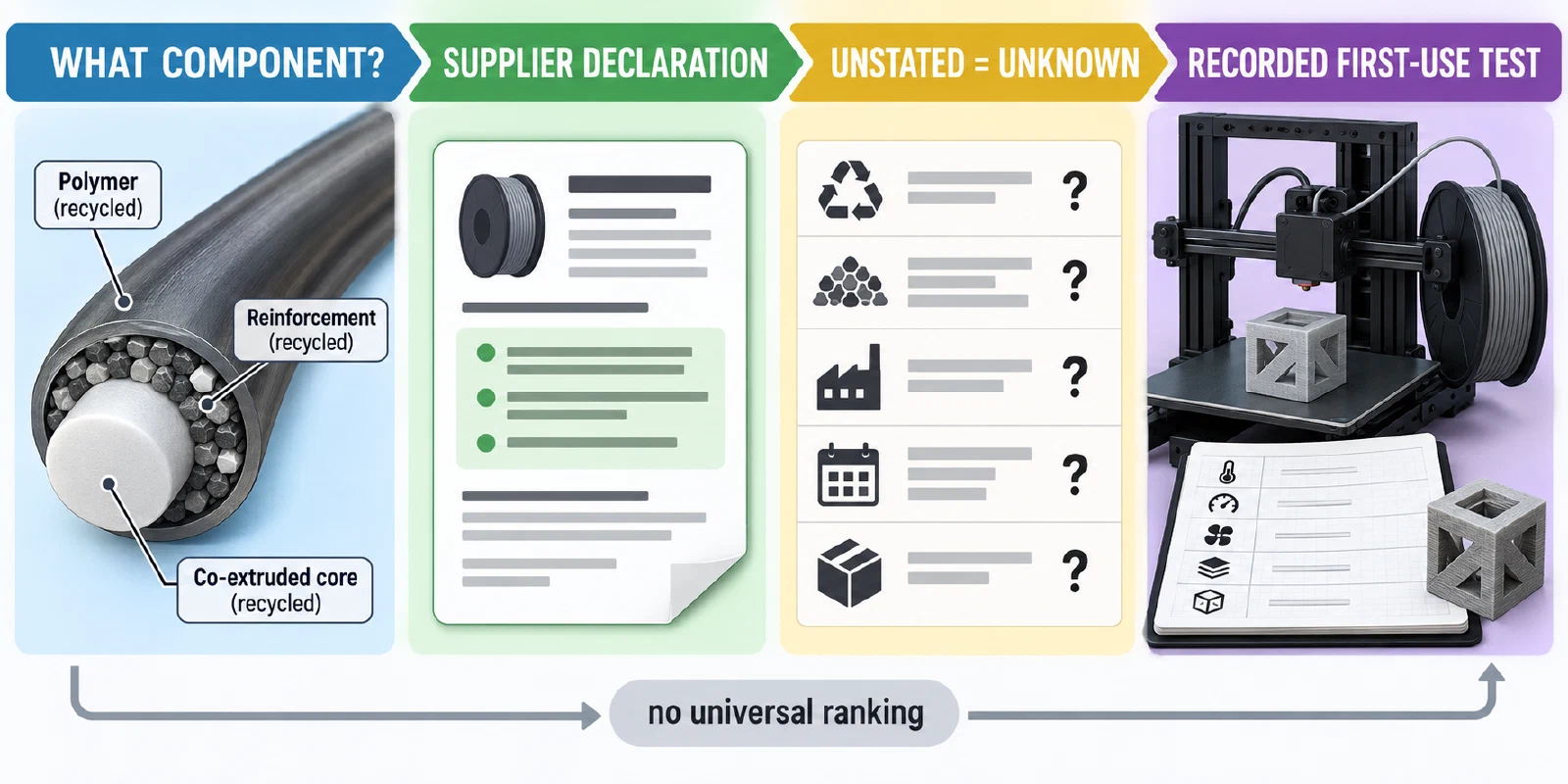
A recycled-content label can describe different parts of a filament. It may refer to the polymer that forms the main material, a reinforcing filler, or a particular layer in a co-extruded strand. Check what the product documentation actually says before comparing spools. A label alone does not establish a printer profile, a printed-part property, or an environmental benefit.
Identify what is recycled
Start with the exact manufacturer, product, grade, and document version. Then look for the recycled component, the stated percentage and what that percentage measures, the feedstock source or processing description, and any lot or color variation. If a document leaves one of these fields blank, record it as not stated rather than estimating it.
These product examples show why the component matters:
| Product example | What the supplier states | What the statement establishes |
|---|---|---|
| Prusament PLA Recycled | Prusa says the product consists of recycled Prusament PLA materials and that batch color varies. | A recycled PLA product declaration for this named filament. It is not a general definition for recycled PLA or a life-cycle assessment. |
| Fiberlogy rNylon | Fiberlogy describes rNylon as 100% recycled PA12 from selected suppliers and notes that raw-material batches may vary in shade and contain trace glitter. | A manufacturer claim and a named PA12 product. The page does not identify a specific feedstock stream or lot-by-lot recycled fraction. |
| Fiberon PETG-rCF08 | The TDS describes PETG reinforced with recycled carbon fiber. | The recycled component is the reinforcement. That wording does not establish that the PETG carrier polymer is recycled. |
A supplier page or data sheet is a primary source for the supplier’s own product claim. It is not, by itself, an independent audit of feedstock history, a batch test, or approval for a particular application. Keep a manufacturer declaration separate from a published lab result and from a print you have observed on your own machine.
Read research in its test context
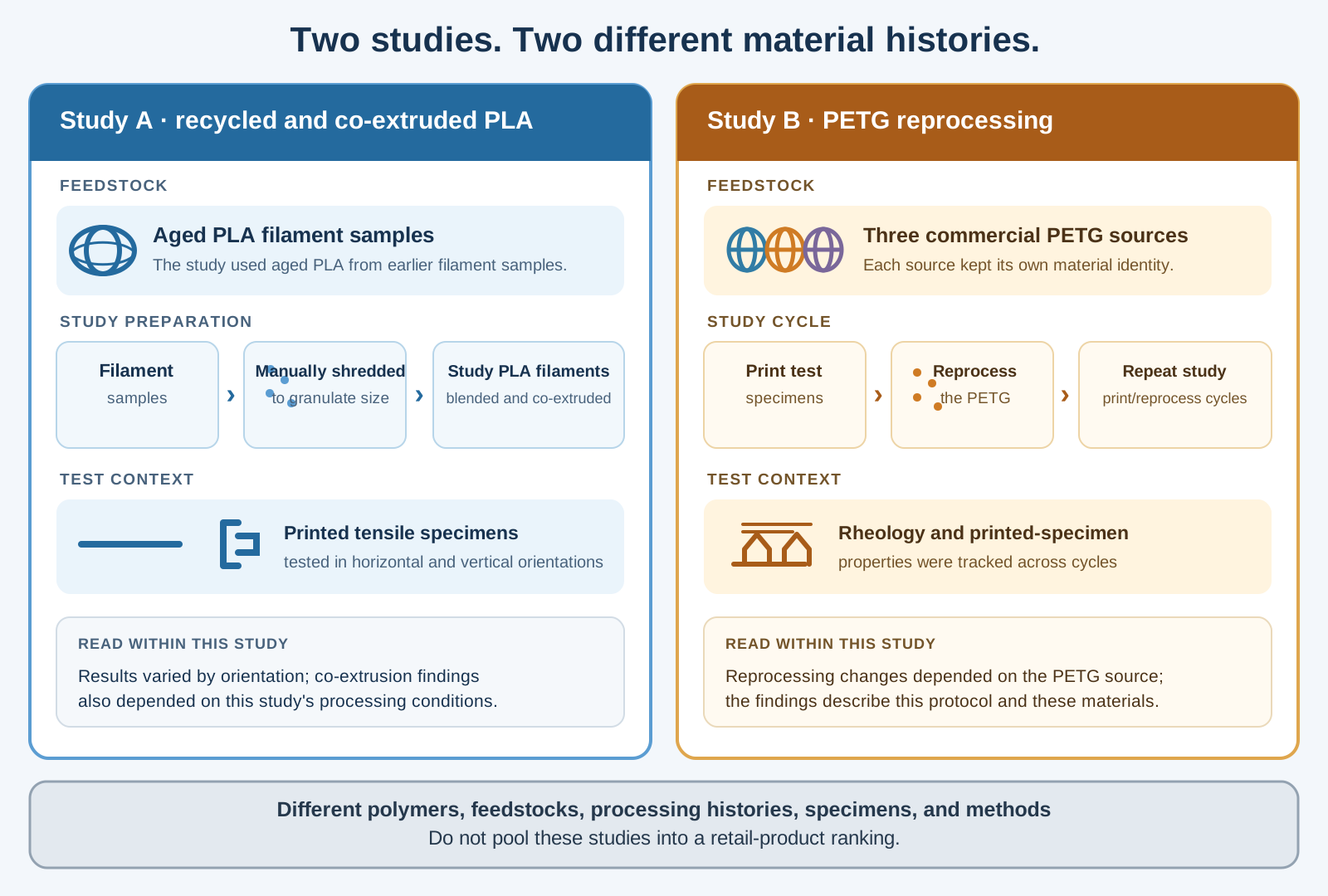
Studies of recycled material use different feedstocks, processing histories, filament geometries, specimen orientations, and measurement methods. In one study of recycled and co-extruded PLA, the reported results varied with specimen orientation; the co-extruded samples also had process-specific geometry and bonding limitations. Those results describe that laboratory material and process, not a retail spool with the same polymer name. A separate PETG study using three commercial sources reported that changes during reprocessing depended on the source material.
These studies help explain why product identity and processing history matter. They do not establish a commercial-spool ranking, a universal recycled-versus-virgin property difference, a safe number of reuse cycles, or a general environmental benefit. Avoid carrying a result from one feedstock or specimen into a different product.
Make a product and first-use record
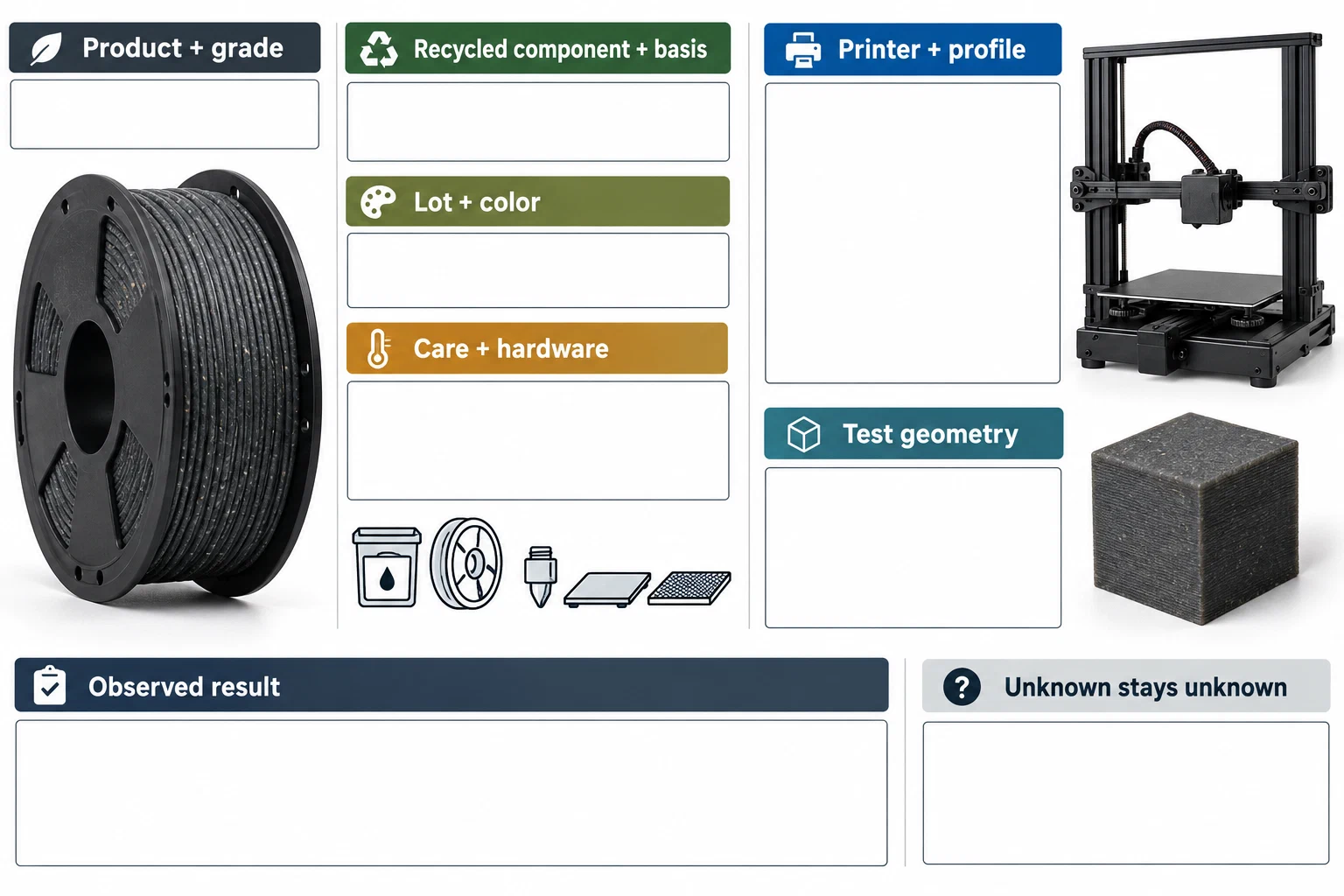
Before loading a new spool, keep the information that lets you interpret what happens:
| Record | What to capture |
|---|---|
| Product identity | Manufacturer, product, polymer or grade, formulation or document version, and source URL. |
| Recycled-content claim | Whether it covers the carrier polymer, a filler, a co-extruded core, or a blend; stated percentage and its basis; source stream or process details when disclosed. |
| Batch and spool | Lot or batch, color, spool construction, filament diameter, and the basis for any stated diameter tolerance. |
| Care and compatibility | Product-specific drying and storage instructions, spool limits, printer, feeder path, nozzle, and build surface. |
| First-use conditions | Slicer and profile version, main settings, test geometry, filament state, date, and observed result. |
Use the product’s own care and hardware instructions. For moisture handling, see Drying and storing 3D-printing filament . For reinforced filament, check abrasive composite compatibility ; for nylon or soluble support, see the high-moisture care workflow .
For a first print, choose a small, non-critical object that exercises the feeding path and the features you care about. Keep the printer, nozzle, surface, and profile recorded; inspect the first layer, feed consistency, surface, and visible faults. If you measure diameter or another value, record the instrument and method and compare it only with a stated product specification. Do not invent an acceptance tolerance.
Interpret the result narrowly
A successful first-use print shows that this spool printed acceptably in the recorded setup and test. It does not establish that another lot will behave the same way, that the filament matches a virgin grade, or that the finished part has a particular strength, durability, safety, or chemical resistance.
If an important source, fraction, or handling field is missing, leave it unknown, ask the supplier for the applicable documentation, or choose a better-documented product. Claims about the finished part’s treatment, exposure, or measured performance need their own evidence and test context; see Part Performance & Post-Processing .
Back to top ↑