A refill can fit a reusable spool and still fail to feed through a printer system. A spool that turns freely in a drybox may not fit an automated feeder. Before buying or loading a refill, check the refill core, complete spool, and receiving system as separate parts of the question. Manufacturer compatibility statements apply to the named products and model generations; they are not independent fit tests.
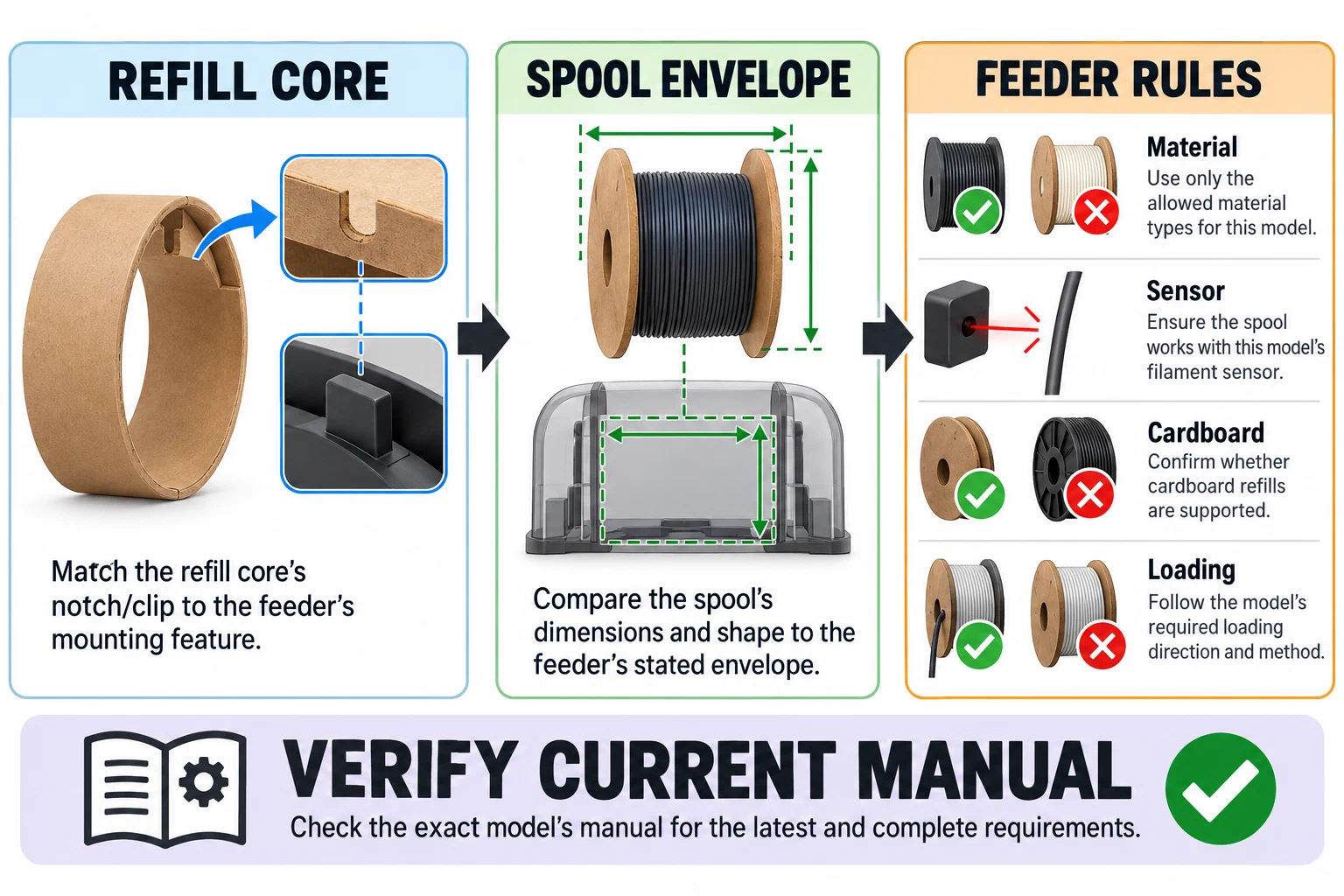
Start with the interface you need
Identify the exact feeder or storage accessory, printer pairing, and hardware generation. “AMS-compatible,” “CFS-compatible,” or “fits a reusable spool” is incomplete without the named model and the product generation behind the claim. A product listing may change as spool cores, side plates, or feeder hardware change, so use its current page and the current system manual when purchasing.
Then separate these checks:
- Refill core to spool. Check whether the core, notch, clip, center, and locking halves match the reusable spool. Core geometry and the assembly procedure can differ by brand and generation. Follow the exact refill and spool instructions; do not force a part that does not seat or lock as described.
- Complete spool to system. Compare the spool’s outside diameter, width, wall or flange shape, and any other dimensions the manufacturer specifies with the exact feeder’s allowed envelope. A “standard 1 kg” label does not give enough dimensions to establish a fit.
- Feed and recognition rules. Check material exclusions, cardboard-spool restrictions, sensor or label position, filament path, and any loading direction. RFID or a spool label may populate information in a particular system, but recognition does not prove mechanical fit, material suitability, or dry condition.
- Storage-holder fit. For a passive drybox, check the spindle or support points, free rotation, lid clearance, and filament exit. This is a different fit question from a driven multi-spool feeder.
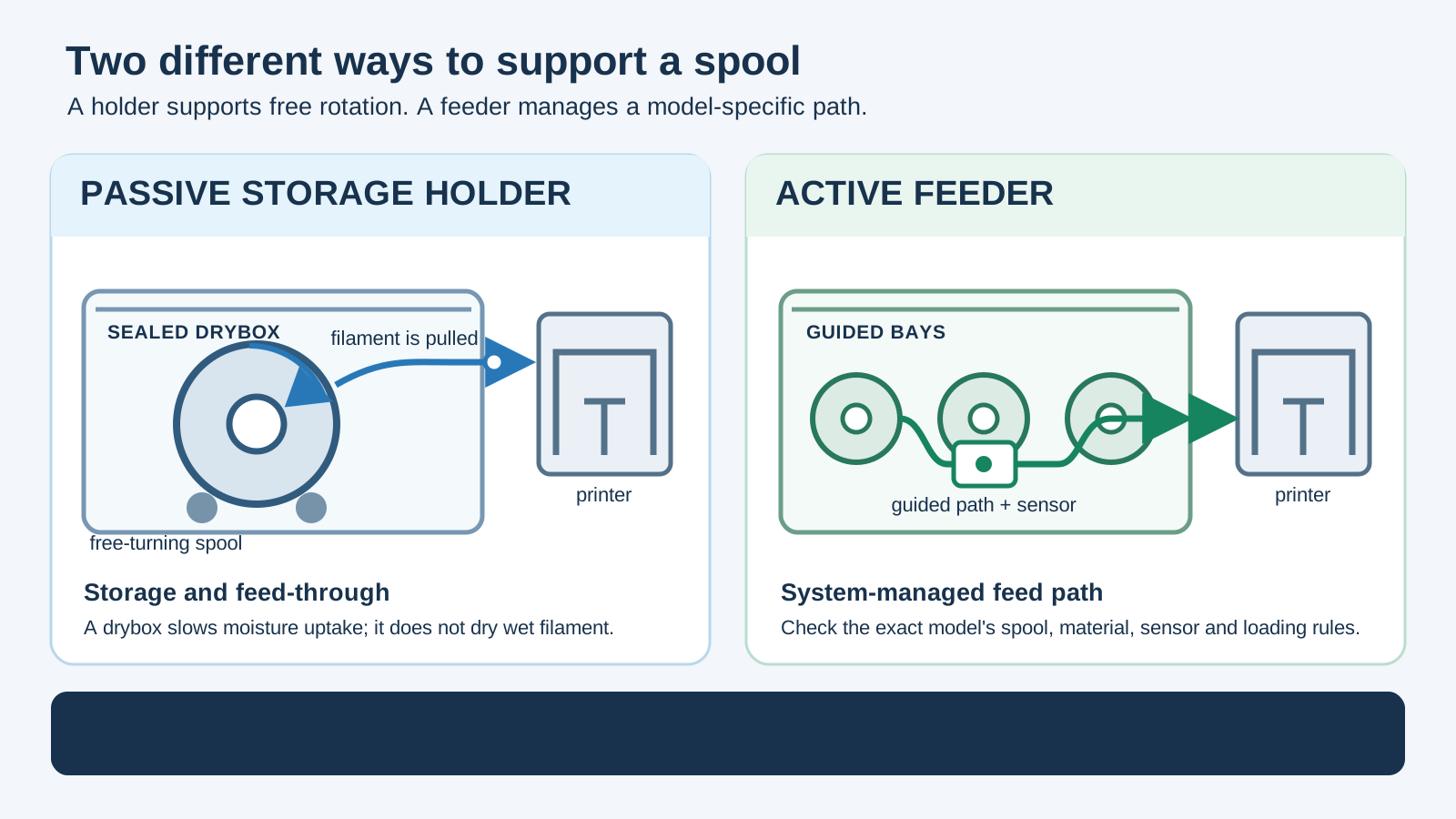
Why the model and generation matter
Manufacturer examples show why one compatibility claim should not be generalized. Prusament’s newer plastic-center spool uses a 900 g refill, while its legacy cardboard-center design uses a different 1 kg refill; Prusa’s instructions distinguish the generations. These are product-specific loading rules, not a shared refill-core standard.
System manuals define different constraints too. Anycubic publishes spool dimensions for ACE Pro, and the Creality CFS manual gives its own diameter and width limits along with material exclusions. Those limits describe those systems only. A supplier’s statement that one refill works with a named reusable spool is useful evidence to investigate, but it does not establish that the assembled spool fits every feeder paired with that spool.
The Bambu Lab loading guide distinguishes its 250 g and 1 kg refill handling. Keep the protective strap on during assembly as instructed, and use the matching current guide for the refill format in hand; those steps do not establish third-party core fit.
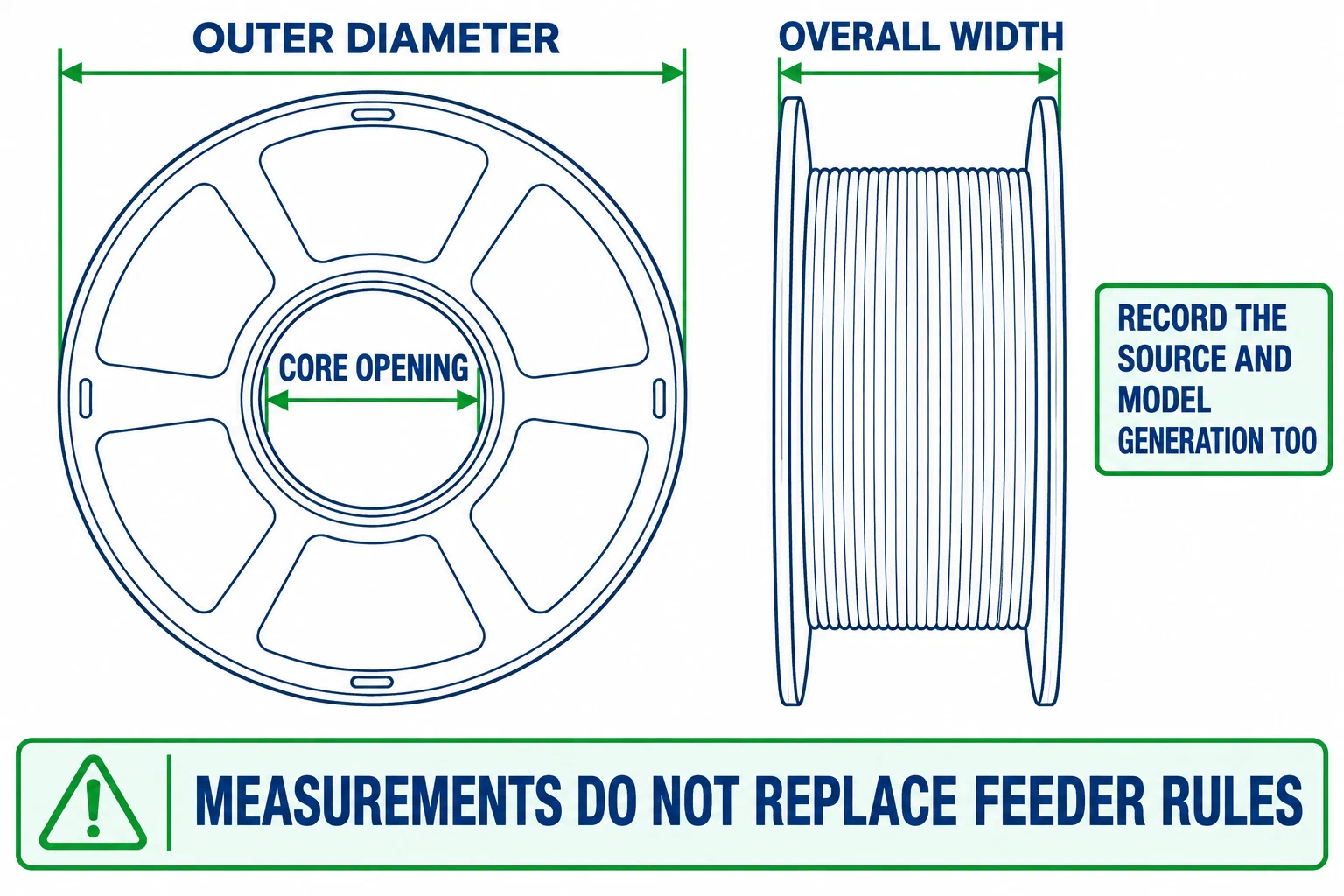
Make a fit record before loading
For a new refill or spool, keep a short record that another person can check:
| Record | What to capture |
|---|---|
| System | Feeder or drybox name, exact model, generation, and paired printer where relevant |
| Filament product | Brand, refill or spool product, material, size, and current product-page version/date |
| Mechanical fit | Core/spool pairing, stated dimensions, adapter or spool-side requirements, and the source for each claim |
| Feed conditions | Material allowance, spool construction, sensor/label requirements, path, and loading instructions |
| Result | Whether assembly and manual loading completed normally; note any rubbing, wobble, slipping, tangling, or sensor state without treating one successful load as broad validation |
If the source names a different generation, omits a critical dimension, or gives conflicting instructions, stop short of assuming compatibility. Ask the supplier for the exact product pairing or choose a spool explicitly documented for the system. Do not modify the spool or bypass a sensor to make an uncertain combination work.
After fit is established, check the filament’s own care requirements. A sealed drybox may help maintain a dry state, but it is not automatically an active dryer; see drying and storing filament . Moisture-sensitive materials, composites, and flexible filaments may also have material-specific feeder restrictions; see the high-moisture care workflow , abrasive composite guide , and material choice guide .
What a fit check does not prove
Compatibility language and manual dimensions are manufacturer specifications, not independent tests of every product combination. A physical assembly or successful feed in one setup does not establish fit in another generation, reliable automated switching, print quality, or the filament’s condition. Keep those outcomes separate and record the exact products and system used.
Back to top ↑